USAID DEC
Fast-track treatment initiation counselling in South Africa: A cost-outcomes analysis
Sign inTHE WORLD BANK
Fast-track treatment initiation counselling in South Africa: A cost-outcomes analysis
The National Adherence Guidelines for Chronic Diseases in South Africa were launched by the National Department of Health in 2015.
2021 · 14 pages
Sign in to readA free account is required to download.
Abstract
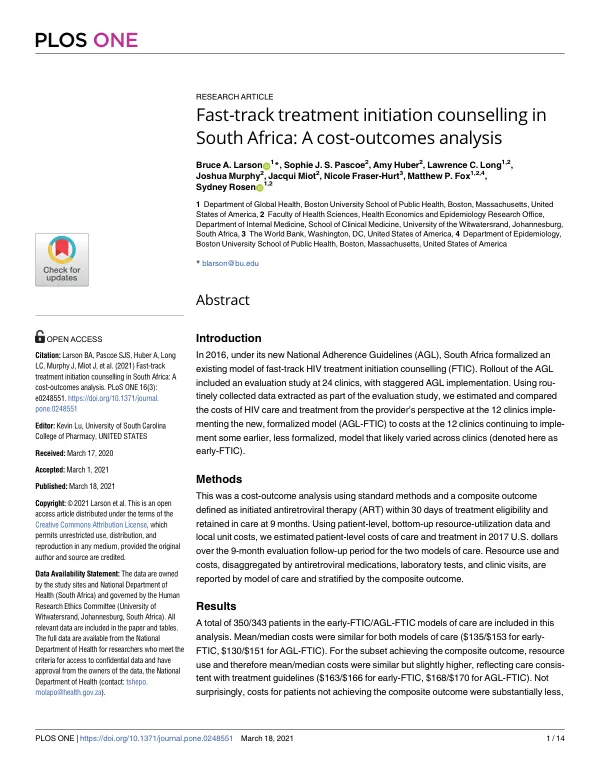
The guidelines included "fast-track treatment initiation counselling" (FTIC), designed to standardize HIV treatment education, counselling, and support provided to patients starting antiretroviral therapy (ART) without delaying treatment initiation. The goal of FTIC was to reduce losses between known eligibility for ART and ART initiation by reducing the number of clinic visits prior to initiation and restructuring the counselling and education program during clinic visits. Prior to national rollout of the guidelines, the National Department of Health and its partners identified 24 clinics where guideline implementation would be staggered to facilitate a cluster-randomized study to evaluate impacts of the adherence interventions on various treatment outcomes. Patients were enrolled in this Adherence Guidelines Evaluation (AGL) study between January and December 2016, with follow-up through 2017. Results from the AGL study showed a modest (6%) increase in the proportion of patients initiated within 30 days but a modest decrease in the proportion retained over the original 9 months main follow-up period. The 2015 guidelines did not specify the timing of adherence counselling relative to ART initiation, but they did state that such counselling should begin on the day of HIV diagnosis, be provided monthly for the next 3 months, and then be offered quarterly. As a result of this gradual evolution of treatment initiation and counselling guidelines, public clinics in South Africa, including the 24 AGL evaluation study clinics, were already implementing some form of "faster-track" initiation that incorporated adherence counselling when the AGL were released. However, they did not have consistent expectations on the timing and content of counselling sessions relative to ART initiation. The newer, formalized FTIC model provided explicit guidance on the timing and content of adherence counselling sessions relative to ART initiation. The guidelines called for patients to receive four adherence counselling sessions: one on the day of ART eligibility; one session seven days later; and then two additional counselling sessions at subsequent clinic visits (at one- and two-months on ART). The overall goal of this new FTIC model was to standardize adherence counselling (timing and content) as part of the initiation process and reduce barriers to ART initiation, with the goal of increasing adherence and retention. A cost-outcomes analysis was conducted to estimate and compare the costs of HIV care and treatment from the provider's perspective at the 12 clinics implementing the new, formalized model (AGL-FTIC) to costs at the 12 clinics continuing to implement some earlier, less formalized, model that likely varied across clinics (denoted here as early-FTIC). The analysis used patient-level, bottom-up resource-utilization data and local unit costs to estimate patient-level costs of care and treatment in 2017 U.S. dollars over the 9-month evaluation follow-up period for the two models of care. The results showed that mean/median costs were similar for both models of care, with slightly higher costs for the subset achieving the composite outcome.
Related documents