USAID DEC
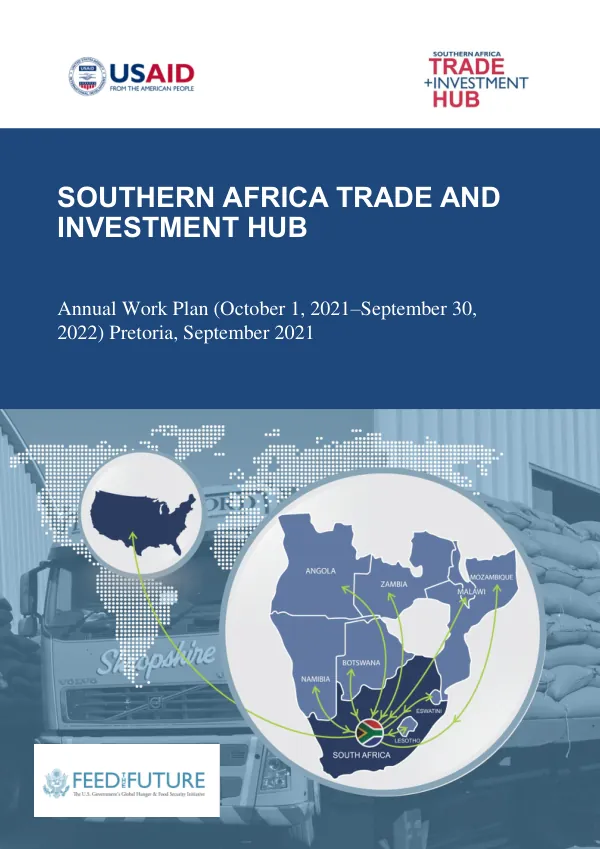
Southern Africa Trade and Investment Hub Annual Work Plan (October 1, 2021–September 30, 2022)
Sign inDAI GLOBAL, LLC
Southern Africa Trade and Investment Hub Annual Work Plan (October 1, 2021–September 30, 2022)
The Southern Africa Trade and Investment Hub is a program aimed at promoting trade and investment between the region and South Africa.
2021 · 102 pages
Sign in to readA free account is required to download.
Abstract
The program is funded by the United States Agency for International Development (USAID) and is implemented by DAI Global, LLC. The program's primary objective is to increase exports from the region to South Africa and to promote investment from South Africa to the region. The program has four main objectives: increased exports to South Africa from the region, increased investment out of South Africa to the region, sustainable AGOA utilization by the Southern African countries, and Zambia buy-in. The program's strategy is based on a logical framework that outlines the goals, objectives, and indicators for each of the four objectives. The program's technical activities are guided by several principles, including the need to promote sustainable economic growth and development in the region. The program's regional economic context is characterized by a growing economy in South Africa, which presents opportunities for trade and investment opportunities for the region. The program's targeted sectors for exports from the region to South Africa include textiles, leather, and textiles-related products, as well as agricultural products. The program's investment services are designed to support partner firms in the region, including providing training and technical assistance to help them prepare for investment opportunities in South Africa. The program's selection criteria for investment services includes the firm's potential for growth and job creation, as well as its ability to contribute to the region's economic development. The program's management and administration are managed by a team of professionals who are responsible for overseeing the program's activities and ensuring that it is implemented in accordance with USAID's policies and procedures. The program's monitoring and evaluation activities are designed to track progress towards the program's objectives and to identify areas for improvement. The program's country implementation plans outline the specific activities and interventions that will be implemented in each country. The plans are designed to take into account the unique needs and circumstances of each country and to ensure that the program's activities are tailored to meet those needs. The program's indicator table and targets outline the specific indicators that will be used to measure progress towards the program's objectives. The indicators include the value of exports from the region to South Africa, the number of jobs created through investment, and the number of firms that have received training and technical assistance. The program's facilitated exports to South Africa for FY2021 until FY2021 Q3 totaled $1.2 million. The program's partner TPSPs by country include Angola, Botswana, Eswatini, Lesotho, Mozambique, Namibia, and South Africa. The program's objective 1 output includes the value of exports from the region to South Africa, which is expected to increase by 20% by the end of the program. The program's objective 2 output includes the number of jobs created through investment, which is expected to increase by 15% by the end of the program. The program's objective 3 output includes the number of firms that have received training and technical assistance, which is expected to increase by 25% by the end of the program. The program's objective 4 output includes the level of Zambia's buy-in, which is expected to increase by 30% by the end of the program. The program's strategic communications and knowledge management activities are designed to promote the program's goals and objectives, as well as to share knowledge and best practices with stakeholders. The program's monitoring and evaluation activities are designed to track progress towards the program's objectives and to identify areas for improvement.