DEVELOPMENT ALTERNATIVES, INC./FINNET
Accessible Finance Activity Final Report
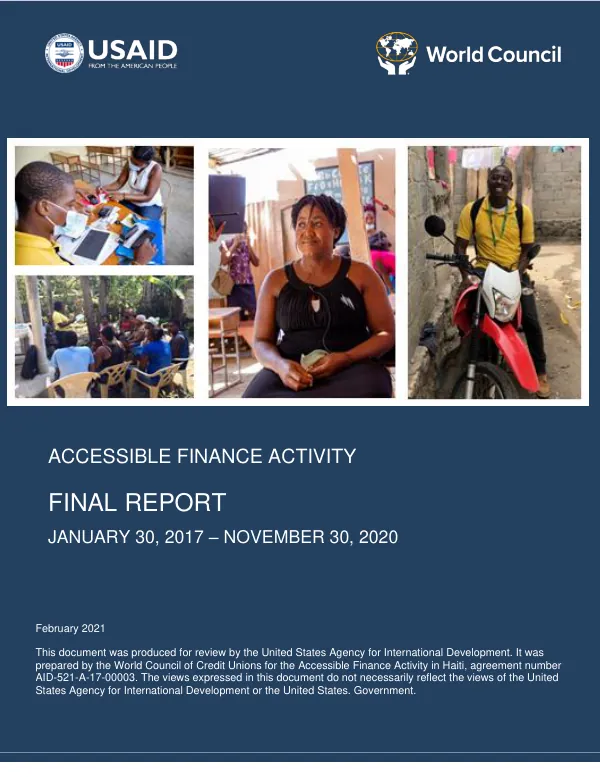
The Accessible Finance Activity, a pilot program implemented by World Council of Credit Unions (WOCCU) in Haiti from 2017 to 2020, aimed to further financial inclusion in the country.
2021 · 95 pages
Sign in to readA free account is required to download.
Abstract
The program supported USAID's overarching Assistance Objective in Haiti's Strategic Framework (2018-2020) of creating a foundation for resilience, stability, and inclusive growth. It also aligned with the Haitian Central Bank's financial inclusion strategy to create a financially and economically more inclusive society. The program had two main objectives: to expand financial services and products to rural areas through groups and digital financial services, and to sustainably address liquidity and capital challenges faced by microfinance institutions (MFIs) and credit unions. To achieve these objectives, the program employed a holistic approach that included field officer banking methodology, leveraging mobile and digital technologies, and addressing liquidity and capital challenges. The field officer banking methodology, known as "KPPP" (My Credit Union Close to Me), involved rural agents bringing access to financial services and financial education to underserved rural communities. This approach helped increase credit union membership, deposits, and disbursements, as well as improve financial literacy among participants. The program also focused on leveraging mobile and digital technologies to improve credit unions' core banking systems, enabling rural agents to serve members in the field using digital tools, and setting up the Intermediary Agents component to further access accounts through third-party points of service. To address liquidity and capital challenges faced by MFIs and credit unions, the program developed client-driven products and strategies to reduce short, medium, and long-term loans' cash flow matching constraints. Credit unions developed six new savings products, and twenty-nine credit unions adopted these products, while twenty-one credit unions developed new savings products. The program's impact was significant, with an estimated 62% of new credit union members being women, and a total of 4,215 new members joining credit unions. The program also facilitated disbursements worth HTG 25,211,250 (approximately USD 400,179) and improved financial literacy for 3,552 participants. The Accessible Finance Activity's success was attributed to its holistic approach, which combined field officer banking methodology, leveraging mobile and digital technologies, and addressing liquidity and capital challenges. The program's impact on financial inclusion in Haiti was substantial, and its lessons learned can be applied to future initiatives aimed at promoting financial inclusion in the region.