USAID DEC
Haiti Justice Sector Strengthening Program Monitoring, Evaluation, and Learning Plan
Sign inCHEMONICS
Haiti Justice Sector Strengthening Program Monitoring, Evaluation, and Learning Plan
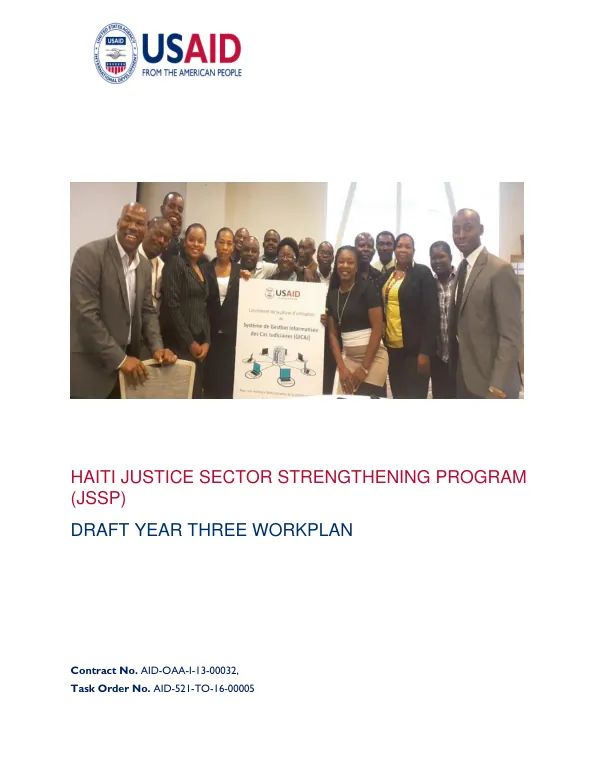
The Justice Sector Strengthening Program (JSSP) aims to support the Government of Haiti (GOH) and civil society in expanding access to quality justice for Haitian citizens.
2021 · 89 pages
Sign in to readA free account is required to download.
Abstract
The project's goal is to improve the legal, regulatory, and institutional framework of the Haitian justice sector, advancing core justice sector strengthening while building the foundations for judicial reform. JSSP is contributing to the "Post-Earthquake USG Haiti Strategy Toward Renewal and Economic Opportunity," under Pillar D, Governance and Rule of Law. The project's development hypothesis is that by modernizing the enabling environment for justice, strengthening justice sector institutions, and expanding pathways to justice services, Haitian citizens will be able to access quality justice. The project's results framework demonstrates the logical relationships between the different levels of anticipated results. The framework shows that the project's goal is directly linked with the USG's foreign assistance objective of governing justly and democratically. The project's methodology for monitoring and evaluation (MEL) involves setting early and tracking results consistently to determine whether the project is meeting its performance requirements. The MEL plan will be used to plan and measure the success of the project in expanding Haitian citizens' access to quality justice services. The project's MEL team will be responsible for overseeing the implementation of the MEL plan. The Deputy Chief of Party (DCOP) will supervise the MEL team and lead the technical staff, grantees, and implementing partners in developing the necessary tools and methods. The project partners, including sub-contractors and grantees, will assist in collecting data within their spheres of work. The project's MEL approach involves collaboration with the entire program team and relevant stakeholders. Performance management will involve the finalization of indicators, data collection, analysis, and learning. The project will use a performance management system to track progress and make adjustments as needed. The project's performance indicators, data sources, and collection methods will be outlined in the performance indicator tracking table (PITT). The MEL plan will be used to regularly update and collaborate with relevant stakeholders, including USAID, to ensure achievement of results. The project's geographic focus is on the Port-au-Prince, Croix-des-Bouquets, Saint-Marc, Cap-Haitien, and Fort-Liberte areas. The project will expand the CMIS to 6 additional jurisdictions, including Grande-Rivière-du-Nord, Hinche, Mirebalais, Gonaïves, Petit-Goâve, and Jacmel. The project's timeframes are from February 7, 2021, to February 6, 2022. The project's budget is not specified in the provided text.