USAID. MISSION TO UGANDA
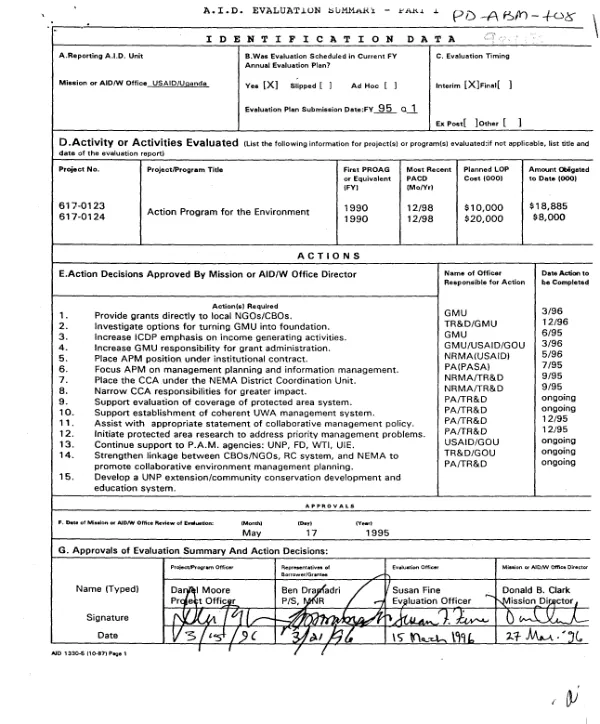
Action program for the environment
Summarizes recommendations from the mid-term evaluation (XD-ABM-708-A) of the Action Program for the Environment (APE), aimed at helping Uganda"s public and private sectors to more effectively and sustainably manage the natural resource base in selected areas through policy reform, national environmental action planning, and resource rehabilitation and conservation.
1996
Sign in to readA free account is required to download.
Abstract
The evaluation covered the period 8/91-5/95. Overall, APE has had extremely positive results. The National Environment Action Plan is finished and the Environmental Bill has been passed. Decentralization of environmental management is well underway. Uganda National Parks (UNP) has increased its area under protection and improved financial accountability. Community participation in park management has begun. The Grants Management Unit (GMU) has been established. Major recommendations for APE are as follows. (1) Continue to support the Government of Uganda"s establishment of a coherent system for managing its wildlife resources and protected areas. (2) Assist in preparing a policy statement on collaborative management/community conservation committee composition, role, and support. (3) Review the GMU to make it more responsive to needs and priorities of local communities. (4) Investigate options for turning the GMU into a more autonomous, self-sustaining organization. (5) Improve coordination of TA. (6) Commission a study to evaluate the protected area system"s coverage of Uganda"s biodiversity. (7) Continue material/technical support to protected area management agencies, i.e., continue support to UNP, enabling it to further develop or rehabilitate infrastructure; support the Forest Department, enabling it to open new and maintain existing roads, train staff, examine the value to buffer communities of developing exotic species plantations as a way to reduce dependence on indigenous trees; and offer soft loans to encourage private sector participation in plantation programs. (8) Strengthen linkages among community-based groups, local NGOs, the Resource Conservation system, and the National Environmental Management Act. (9) Develop a UNP extension/community conservation development and education system. (10) Support protected area research which addresses priority management problems.
![Action program for the environment : mid-term evaluation (project no. 617-0124[PA], 617-0123[NPA])](https://covers.devme.ai/gen/6696.webp)