USAID DEC
Action program for the environment : mid-term evaluation (project no. 617-0124[PA], 617-0123[NPA])
Sign inINTERNATIONAL SCIENCE AND TECHNOLOGY INSTITUTE, INC. (ISTI)
Action program for the environment : mid-term evaluation (project no. 617-0124[PA], 617-0123[NPA])
Evaluates the Action Program for the Environment (APE), aimed at helping Uganda's public and private sectors to more effectively and sustainably manage the natural resource base in selected areas.
Matt, Lisa M.|Karch, Ed
Sign in to readA free account is required to download.
![Action program for the environment : mid-term evaluation (project no. 617-0124[PA], 617-0123[NPA])](https://covers.devme.ai/gen/6696.webp)
Abstract
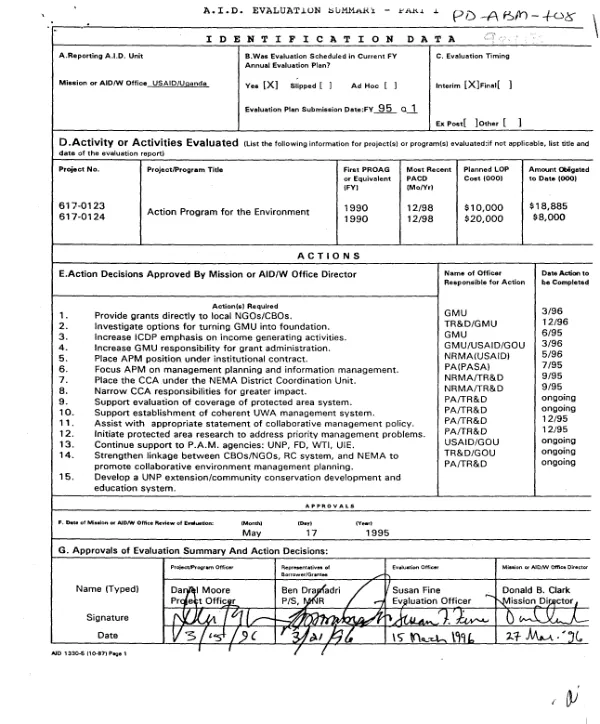
Mid-term evaluation covers the period 8/91-5/95. Overall, APE has had extremely positive results. In the policy and institutional development component, the National Environmental Action Plan (NEAP), developed with the participation of a wide base of stakeholders, is finished, and the Environmental Bill has been passed. APE is supporting the transition from NEAP to the National Environment Management Act (NEMA). Decentralization of environmental management has begun, and the results in Kasese District are extremely encouraging and can serve as a model for other work. However, there are still many problems to be resolved before elected officials, civil servants, and local communities are genuinely able and committed to collaborative planning and decision making. APE has provided support to the three agencies currently managing protected areas -- Uganda National Parks (UNP), the Games Department (GD), and the Forest Department (FD), with UNP the main beneficiary. Material support (vehicles, fuel, costs of boundary demarcations, construction, and some operating expenses) has been especially appreciated, as USAID is one of the few donors that provides it. A major need is to ensure the effective merger, as proposed by the Government of Uganda (GOU), of UNP and GD into the Uganda Wildlife Authority (UWA). In the rehabilitation and resource conservation component, none of the U.S. PVOs applying to head the Grants Management Unit (GMU) met USAID criteria, leading USAID to assume the task before turning it over to the institutional contractor in 1993, by which time many funds had been committed and many precedents set for project preferences and selection. The GMU is doing an excellent job within this framework. To date, however, no funding has been disbursed to a project actually approved by the GMU, mainly due to USAID's failure, until 2/95, to establish a formal review process. Additionally, no local NGOs have been funded, due to lack of local currency funding and USAID's stringent registration requirements. Nonetheless, APE has funded a large number of activities, mainly related to the conservation of protected areas and the development of the areas associated with those protected areas. There are both pros and cons to the fact that grant funding was largely predetermined from the beginning of the project. The advantage is that USAID was able to channel funds to projects and institutions with proven track records and had a high probability of success. On the negative side, the approach set precedents for the type of activity that USAID preferred to fund. Finally, most project activities do not emphasize individual income generation, especially in reference to marketing of farm produce, the value added by simple technologies, or the development of off-farm small enterprise activities. Projects rely mostly on tourism, revenue sharing, and multiple use for income generation. For recommendations, see the abstract of PD-ABM-708.
Related documents