USAID. MISSION TO MALI
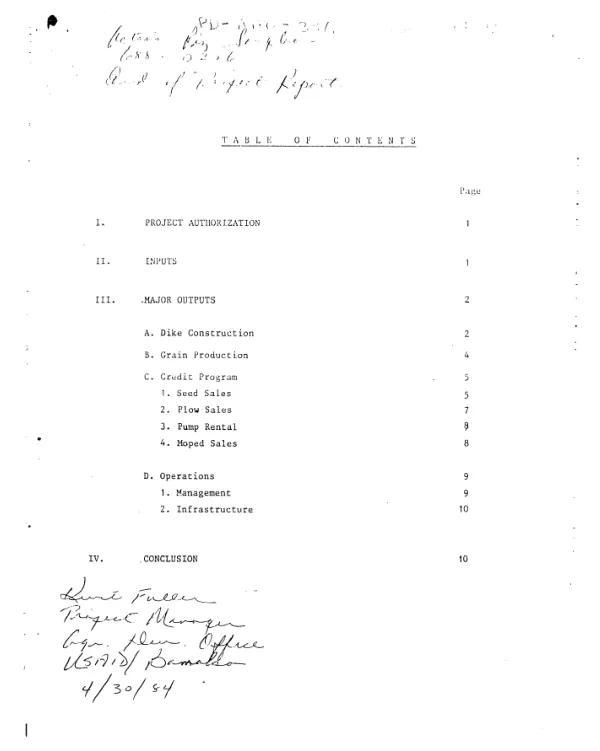
Action Riz-Sorgho project evaluation
Evaluates project to increase sorghum and rice production in the Gao Region of Mali.
1981
Sign in to readA free account is required to download.
Abstract
Special evaluation covers the period 1977-6/81 and is based on site visits, document review, and interviews with project staff and beneficiaries. While some outputs have been achieved, overall agricultural production has not been improved. This has been due to poor understanding of traditional cultivation, leading to the use of a technical package which required excessively early planting, underestimated the growth cycle, and did not entail leveling of newly irrigated land. In addition, extensionists were too few, poorly trained, and reached (at most) 6,400 of the 10,000 targeted farmers. Cited as achievements are the construction of a new Gao administration building and of insubmersible dikes, the latter to protect 1,310 ha of the planned 5,000 ha in Tacharane and Gargouna; preparation of a research and seed production facility in Bagoundie to open 6/81; provision of inputs for farmers and earth-moving equipment for dike construction; U.S. training of three agronomists; and on-the-job experience for construction teams. Flood gates and fish screens serving 1,000 of a planned 5,000 ha have been repaired but their impact has not been assessed. In 1980-81, sorghum was harvested from 3,374 ha, surpassing the goal of 3,300 ha, and the total harvest of 1,932 tons was more than double that of the previous year (851 tons); however, the yield of 440 kg/ha was below the goal of 600 kg/ha. From 1976-77 to 1978-79, rice production increased from 4,295 to 6,173 tons -- approximately half of the project increase -- and hectarage rose 65%. Production plummeted during the disastrous 1979-80 season. It is recommended that: (1) USAID/M fund follow-on activities only if the project"s strategy and administration are revamped; (2) research be multipurpose and multi-year, building on traditional farm practices; (3) Malian Agricultural (Ag) Office personnel be trained; (4) agents provide farmers with knowledge and techniques, not material inputs; (5) delivery of inputs to farmers be transferred from the Ag Office to the Regional Cooperative; (6) demonstrations be conducted to prove the value of the new technology; and (7) the Ag Office"s administration section better coordinate project activities.
Related documents