USAID
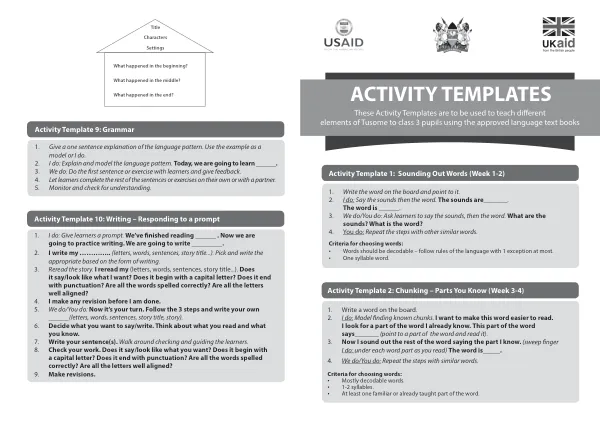
Activity Templates for Reading and Writing
Language Patterns in Grammar Instruction The language pattern being taught today is the explanation of a grammatical concept.
2 pages
Sign in to readA free account is required to download.
Abstract
This pattern typically begins with a statement that introduces the concept, followed by a model or example that illustrates its application. The teacher then guides the learners to repeat the steps with similar words or concepts. Example: "Today, we are going to learn about the use of verb tenses in English grammar. Verb tenses are used to express time and aspect in sentences. For example, the verb 'to be' can be used in the present tense, as in 'I am happy,' or in the past tense, as in 'I was happy.'" Learners are then asked to complete the rest of the sentences or exercises on their own or with a partner, applying the language pattern to different contexts and examples. The teacher monitors and checks for understanding, providing feedback and guidance as needed. This language pattern is essential for learners to develop a deep understanding of grammatical concepts and to apply them in their own writing and communication. By following this pattern, learners can build a strong foundation in language and improve their ability to express themselves effectively. In the context of the Tusome program, this language pattern is particularly relevant for teaching grammar to class 3 pupils. By introducing grammatical concepts in a clear and structured way, teachers can help learners develop a strong foundation in language and improve their ability to read and write with confidence. The language pattern being taught today is a key component of the Tusome program's approach to language instruction. By focusing on the explanation of grammatical concepts, teachers can help learners develop a deep understanding of language and improve their ability to communicate effectively.
Related documents