ENCOMPASS, LLC
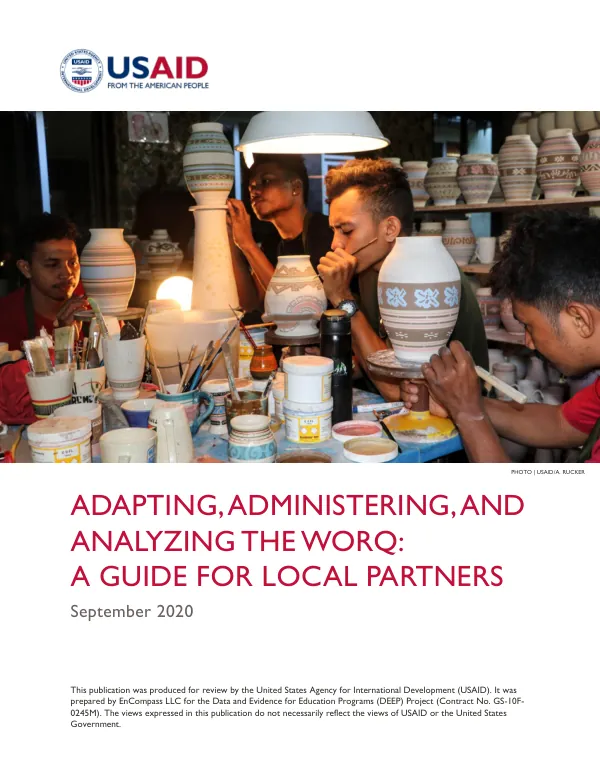
Adapting, Administering, and Analyzing the WORQ: A Guide for Local Partners
The Workforce Outcomes Reporting Questionnaire (WORQ) suite of tools was designed by the United States Agency for International Development (USAID) Office of Education to collect data on youth workforce development activities funded by the U.S.
2020 · 41 pages
Sign in to readA free account is required to download.
Abstract
Government. The WORQ tools are intended to support field-based monitoring, evaluation, and learning (MEL) staff at organizations that monitor and evaluate USG-funded youth workforce development activities. The WORQ suite of tools includes four main sections, each providing specific guidance on the WORQ tool and a list of recommended resources for each topic. The first section, "What Is the WORQ?", introduces the WORQ suite of tools and provides guidance on how to choose the appropriate tool. The second section, "Adapting the WORQ Package for Implementation", lists detailed steps on how to translate, culturally adapt, test, and pilot the WORQ. The third section, "Administering the WORQ", provides guidance on how best to administer the WORQ tools. The fourth section, "Analyzing the WORQ", supplies guidance on job aids to use to analyze the WORQ and a list of illustrative research questions the WORQ helps to answer. The guide also includes five annexes that provide job aids to implement this guidance. The first annex, "List of WORQ Questions Needed for Reporting", lists questions that cannot be cut when adapting the WORQ tools because they are necessary to gather the information needed for standard reporting. The second annex, "Guidance on Using the Open Data Kit (ODK) Tool for Data Collection", provides step-by-step instructions on how to adapt and implement versions of the WORQ suite of tools that have been preprogrammed into ODK. The third annex, "Question Codes and Data Entry Requirements to Use with the WORQ Data Reporting Form", gives directions on how to format question codes and data to use the WORQ Data Reporting Form, a job aid meant to facilitate reporting on the WORQ. The fourth annex, "Example Cognitive Testing "Think-Aloud"", provides an example of how the "think-aloud" process in cognitive testing helped to develop the WORQ tools. The fifth annex, "Data Quality Assurance Checklist", supplies a checklist to use when reviewing the WORQ data from the field to ensure high-quality data. The guide is primarily intended for field-based MEL staff at organizations that monitor and evaluate USG-funded youth workforce development activities. However, it may also be useful for non-field-based MEL staff who want to understand the WORQ and how to implement it. The guide contains hyperlinks throughout to make it easier to return to other sections, and it does not need to be read in order.
Related documents