USAID
DRG Mission Use of Evidence: Findings and Guidance for DRG Activity Planners
The DRG Mission Use of Evidence (MUSE) study identifies different types of evidence used in the design process, including research evidence, contextual evidence, and experiential evidence.
2022 · 2 pages
Sign in to readA free account is required to download.
Abstract
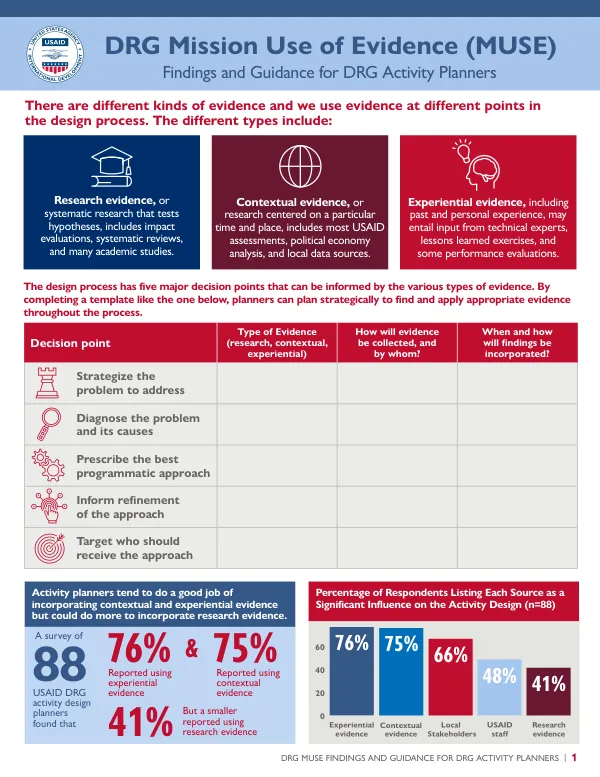
Research evidence is systematic research that tests hypotheses, includes impact evaluations, systematic reviews, and many academic studies. Contextual evidence is research centered on a particular time and place, including most USAID assessments, political economy analysis, and local data sources. Experiential evidence includes past and personal experience, input from technical experts, lessons learned exercises, and some performance evaluations. The design process has five major decision points that can be informed by the various types of evidence. These decision points include strategizing the problem to address, diagnosing the problem and its causes, prescribing the best programmatic approach, informing refinement of the approach, and targeting who should receive the approach. Activity planners tend to do a good job of incorporating contextual and experiential evidence but could do more to incorporate research evidence. A survey of USAID DRG activity design planners found that 76% reported using experiential evidence, 75% reported using contextual evidence, and 41% reported using research evidence. The survey also found that local stakeholders, USAID staff, and research evidence were significant influences on activity design, with 76%, 66%, and 41% of respondents listing each source, respectively. To increase the use of research evidence in the design process, activity design planners can take several measures. First, they can have confidence in their own searching by using evidence maps, such as those compiled by the DRG Center's partner 3ie, and supplementing their search with Google Scholar and OneSearch on USAID's Library. Second, they can commission an evidence review, which can be done on behalf of design teams by the DRG Center's Evidence and Learning Team. Third, they can learn from experts by contacting knowledgeable sources about the research evidence and engaging in formal academic-practitioner peer learning. Fourth, they can require the use of evidence in implementing partner proposals by soliciting research evidence to support a proposed approach as an evaluation criterion. Fifth, they can generate new evidence going forward by planning rigorous evaluations at the activity design stage and using technical support, occasional co-funding, and an evaluation mechanism to support such planning. Finally, they can tap into conversations on the use of evidence by checking out the monthly Learning Digest, the E&L Talk Series, and Facty Friday archive, joining the DRG Learning Community of Practice, or attending the Using Research Evidence training.