DEVTECH SYSTEMS, INC.
Adapting the Rapid Education and Risk Analysis in Colombia: A Companion Brief
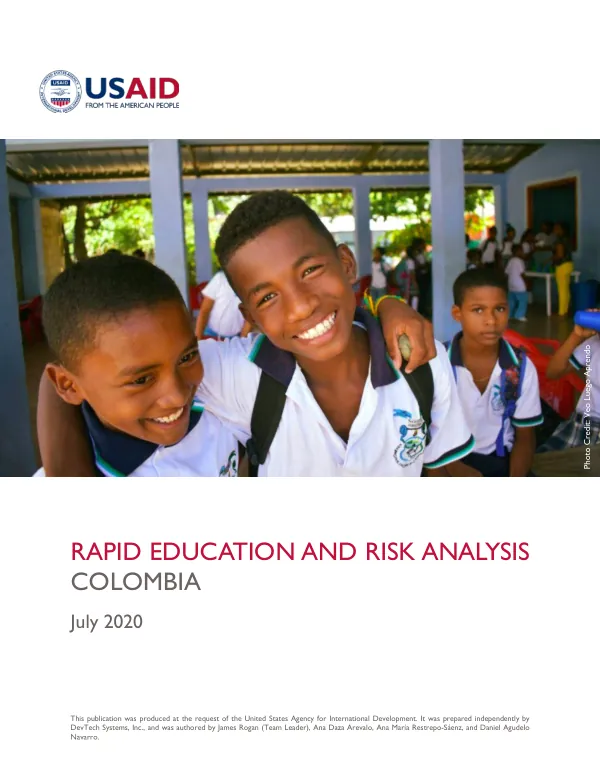
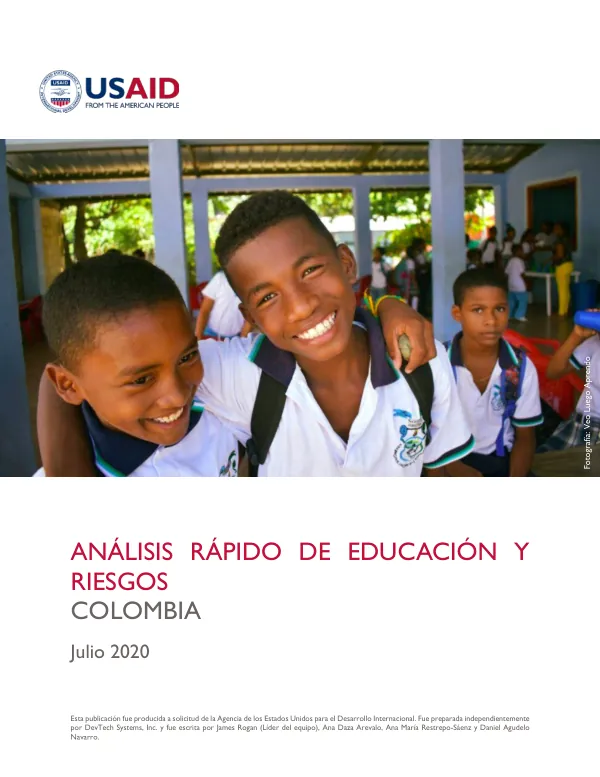
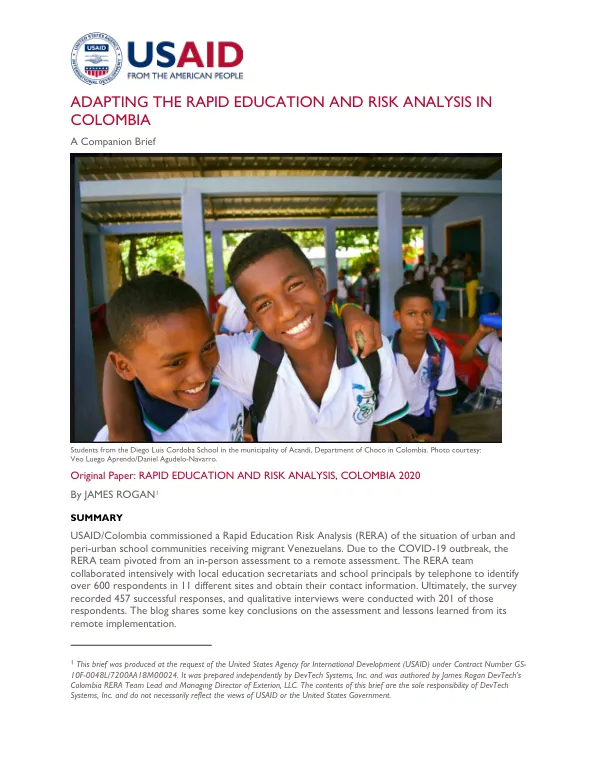
Rapid Education and Risk Analysis (RERA) in Colombia was conducted in response to the COVID-19 pandemic and its impact on urban and peri-urban school communities hosting migrant Venezuelans.
2020 · 5 pages
Sign in to readA free account is required to download.
Abstract
The RERA team, led by James Rogan, collaborated with local education secretariats and school principals to identify and gather data from over 600 respondents across 12 sites. The team conducted a survey and qualitative semi-structured expert interviews, with 457 people responding and 201 participating in interviews. The RERA identified the sale of drugs as the most critical social risk faced by school communities, indicating organized criminal activity. Respondents reported a mix of peaceful coexistence and tension between Venezuelan migrants and Colombians, with some citing discrimination and violence against Venezuelans. Schools made efforts to adapt to remote learning due to COVID-19, with teachers playing a central role in accommodating student needs. Remote learning increased family involvement in education but also accentuated inequalities in access to technology. The RERA highlighted the need for government support to address underlying vulnerabilities and social risks that hamper school community resilience. The COVID-19 crisis has enhanced school community cohesion but also increased the risk of tension and inter-group grievance. The RERA also emphasized the importance of preparedness for new emergencies, particularly during the COVID-19 crisis. Schools were found to be insufficiently prepared, with outdated safety plans and inconsistent evacuation drills. The RERA team developed a concept for adapting the RERA to remote management, which included early explanations of adaptation options and intensive collaboration with local education authorities. Key lessons from the RERA include the importance of early explanations of adaptation options, intensive collaboration with local education authorities, and the use of various technologies to support remote fieldwork. The RERA team also found that contracting a local call center can increase call efficiency and that remote training can be effective with sufficient time. The RERA team used KoboToolbox for the survey and a mixture of Skype and Google Drive for document sharing and live sharing. The team also conducted focus groups, which requires respondent access to technology and data, planning, and team training. In the future, the RERA team would conduct the survey and follow-up interview on the same call to increase the response rate. The RERA team's experience highlights the importance of adaptability and flexibility in conducting research in complex and dynamic contexts. The team's use of remote technologies and collaboration with local education authorities enabled them to gather data and conduct research despite the challenges posed by the COVID-19 pandemic.