USAID DEC
USAID Colombia - Regional Governance Activity - Quarterly Technical Report - OCT-DEC 2019
Sign inGOVERNMENT OF COLOMBIA
USAID Colombia - Regional Governance Activity - Quarterly Technical Report - OCT-DEC 2019
The Regional Governance Activity (RGA) in Colombia began on June 22, 2015, with the aim of improving governance in 40 municipalities affected by the nation's armed conflict.
2019 · 41 pages
Sign in to readA free account is required to download.
Abstract
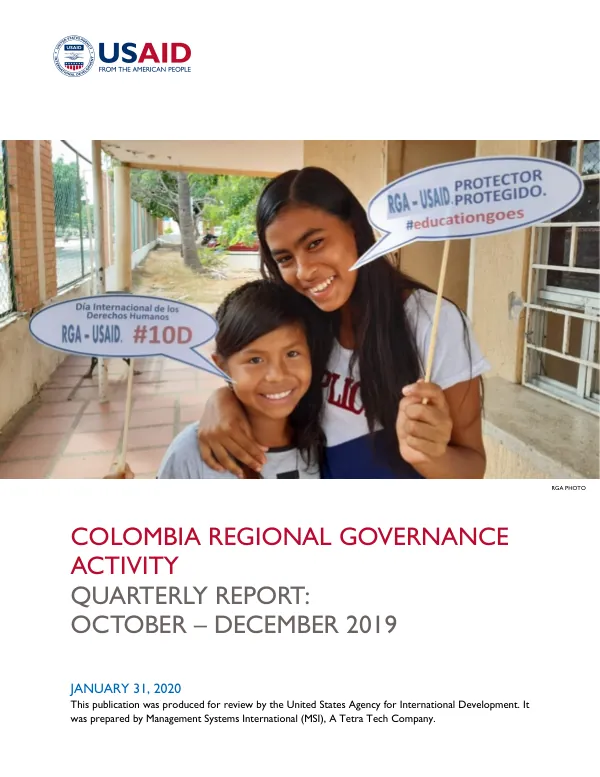
Initially, RGA focused on five program components: decentralization, public financial management, tertiary roads, citizen participation, and electoral reform. On April 23, 2019, RGA was awarded a six-month extension to June 21, 2020, to expand its work through a sixth component. RGA now works with 10 sub-national governments in three border departments—Arauca, La Guajira, and Norte de Santander—to help them cope with the challenges created by the influx of Venezuelan migrants and Colombian returnees in host communities. The activity's focus has shifted to support the sub-national governments in addressing the needs of migrants and returnees. The quarterly report covers RGA activities between October and December 2019, which corresponds to the first quarter of the 2020 fiscal year. The report provides an overview of the national context, RGA progress, accomplishments, and impacts, as well as a summary of RGA coordination with USAID implementing partners and international donors. RGA provided technical assistance to departmental and municipal health secretariats to develop public officials' skills in registering migrants and returnees within the subsidized health care system. This effort resulted in the registration of more than 1,200 migrant minors and returnees within census lists, which is needed for their registration within the subsidized health care regime. RGA also worked with municipal health secretariats to conduct health care information sessions in Maicao and Uribia (La Guajira) to help migrants and returnees better understand requirements and documentation needed to be registered within the health care system. As a result of RGA's support, more than 300 people have been directly registered within the health care system. In addition, RGA assisted 16 public schools in its 10 target municipalities to draft school risk management plans (PEGRs) and helped 13 of these schools reactivate their risk management school committees. RGA support to PEGRs helped schools identify the risks their students face, such as violence, bullying, and lack of access to education. RGA's support to the sub-national governments has resulted in significant progress in improving health service provision and education service provision. The activity's focus on supporting the needs of migrants and returnees has helped to address the challenges created by the influx of Venezuelan migrants and Colombian returnees in host communities. The quarterly report also includes a success story, entitled "Playing Safe," and seven annexes that provide detailed information on selected program elements. Highlights this quarter include support to SNGs to improve health service provision and support to SNGs to improve education service provision. The RGA's support to the sub-national governments has also helped to improve the overall governance in the region. The activity's focus on decentralization, public financial management, tertiary roads, citizen participation, and electoral reform has resulted in significant progress and has helped to improve the overall governance in the region. The quarterly report provides a comprehensive overview of RGA's progress, accomplishments, and impacts. The report highlights the activity's focus on supporting the needs of migrants and returnees and its efforts to improve health service provision and education service provision. The report also includes a success story and seven annexes that provide detailed information on selected program elements.