USAID DEC
Addendum to FANTA Sampling Guide by Robert Magnani (1999): Correction to Section 3.3.1 Determining the Number of Households That Need to be Contacted
Sign inFHI 360
Addendum to FANTA Sampling Guide by Robert Magnani (1999): Correction to Section 3.3.1 Determining the Number of Households That Need to be Contacted
The FANTA Sampling Guide provides guidance on calculating the sample size for baseline and final evaluation surveys conducted by Food for Peace (FFP/T) programs.
2012 · 13 pages
Sign in to readA free account is required to download.
Abstract
The guide suggests using an anthropometric indicator, such as stunting or underweight, which requires collecting data on children under 5 years of age. The initial sample size calculated reflects the number of children in this age category for which data are required. However, most surveys use households (or dwellings) as the basis for sampling within clusters and collect data on eligible children residing in those sampled households. This creates a challenge for sample size calculation, as the correspondence between households and children is not always one-to-one. To overcome this problem, the FANTA Sampling Guide suggests an approach to translate the calculated child sample size into the number of households that need to be visited to ensure the required sample size of children is achieved. The formula for the required sample size, n, is given in Appendix 1 of this addendum. The sample size reflects the number of units on which data should be collected for the indicator in both the baseline and final evaluation surveys. However, when carrying out a survey, it is rare to have a complete list of children from which to sample. Instead, households are sampled, and data are collected on the eligible children residing in those sampled households. To account for households with no eligible children, the initial required sample size needs to be inflated by an amount that accounts for households with no eligible children. The current guidance in the FANTA Sampling Guide suggests inflating the required sample size by an amount equal to the inverse of the estimated average number of eligible children per household. However, past field experience has shown that this approach can underestimate the number of households that should be visited to obtain the required sample size of children. In this addendum, an alternative approach is recommended to inflate the initial required sample size to account for households with no eligible children. The approach involves using a factor, λ, which represents the average number of children of the desired age group per household. The factor, λ, is then used to inflate the initial required sample size, n, by dividing n by λ. This approach is expected to result in a household sample size that is greater than the one suggested by the current FANTA Sampling Guide, but more likely to result in the required sample size for children being achieved. The recommended approach is demonstrated using an example where the required sample size of children is n = 300, and the estimated average number of children under 24 months of age per household is λ = 0.48. The initial required sample size of households is calculated as n ÷ λ = 300 ÷ 0.48 = 625 households. This approach is expected to provide a more accurate estimate of the number of households that need to be visited to obtain the required sample size of children. The FANTA Sampling Guide suggests using a factor, λ, to inflate the initial required sample size, n, by an amount equal to the inverse of the estimated average number of eligible children per household. However, past field experience has shown that this approach can underestimate the number of households that should be visited to obtain the required sample size of children. In this addendum, an alternative approach is recommended to inflate the initial required sample size to account for households with no eligible children. To account
Related documents
Documents in this collection
 2012
2012USAID DEC
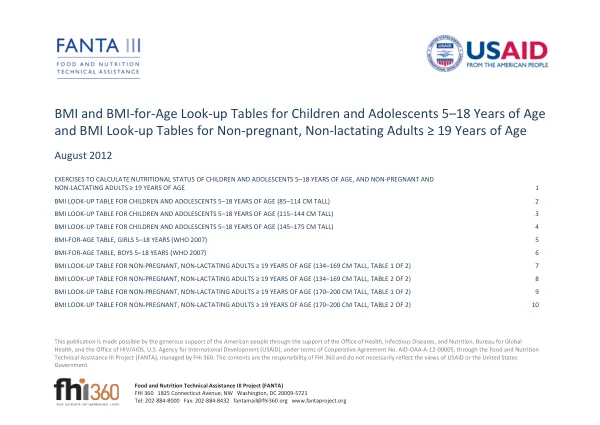
BMI and BMI-for-Age Look-up Tables for Children and Adolescents 5–18 Years of Age and BMI Look-up Tables for Non-pregnant, Non-lactating Adults ≥ 19 Years of Age
Open record 2018
2018USAID DEC