USAID DEC
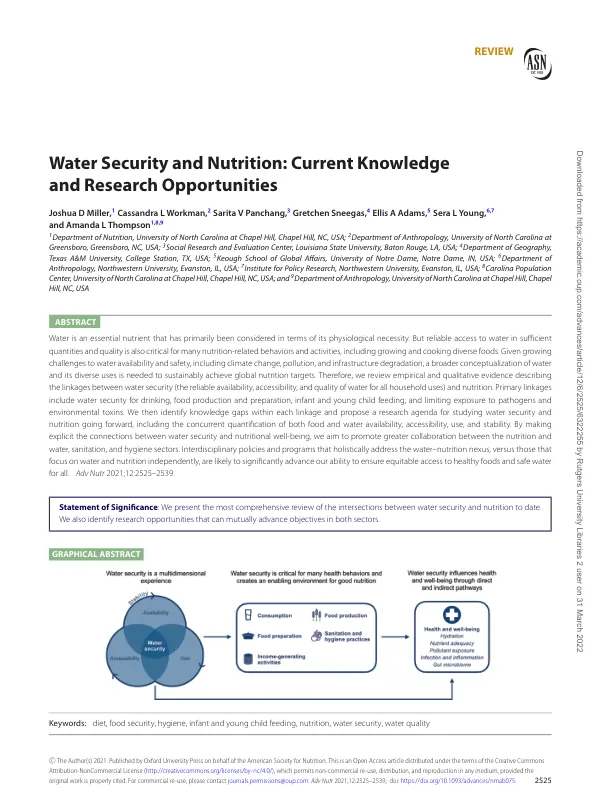
The Importance of Water Security for Ensuring Food Security, Good Nutrition, and Well-being
Sign inINTERNATIONAL FOOD AND POLICY RESEARCH INSTITUTE
The Importance of Water Security for Ensuring Food Security, Good Nutrition, and Well-being
Water security is a critical concept in the field of nutrition, with significant implications for food security, nutrition, and overall well-being.
2021 · 16 pages
Sign in to readA free account is required to download.
Abstract
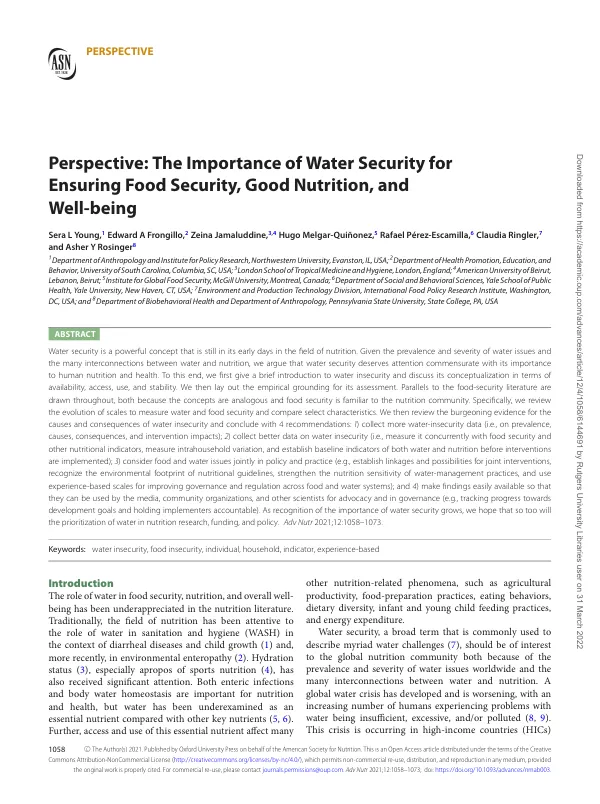
The global water crisis, characterized by insufficient, excessive, and polluted water, affects over half of the world's population, with severe freshwater scarcity experienced by 4 billion people at least once a year. This crisis is driven by rapid population growth, economic growth, and urbanization, which increase domestic and irrigation water demands. Aging infrastructure and underinvestment in water sector operations and maintenance exacerbate these challenges. The concept of water security has been underappreciated in the nutrition literature, with most research focusing on physical measurements of water at the population or hydrological unit level. However, recent studies have investigated the impact of water access and use on individuals and households, highlighting the importance of considering water security in relation to food security and nutrition. Research has shown that water security is closely linked to food security, with water scarcity affecting agricultural productivity and food production. The measurement of water security has evolved over time, with researchers developing scales to assess water access, use, and use stability. These scales have been used to investigate the impact of water insecurity on food security and nutrition outcomes, such as child growth and development. Studies have also highlighted the importance of considering water security in relation to other nutrition-related phenomena, such as agricultural productivity, food-preparation practices, and dietary diversity. The global water crisis has significant implications for food security, nutrition, and human well-being. Water scarcity affects agricultural productivity, leading to reduced crop yields and food availability. Water pollution also affects food safety, with chemical and biological contaminants found in water sources worldwide. The frequency and severity of water-related challenges are increasing, with over 4 billion people experiencing severe freshwater scarcity at least once a year. Research has shown that water security is closely linked to food security, with water scarcity affecting agricultural productivity and food production. Water insecurity also affects food-preparation practices, dietary diversity, and infant and young child feeding practices. The measurement of water security has evolved over time, with researchers developing scales to assess water access, use, and use stability. These scales have been used to investigate the impact of water insecurity on food security and nutrition outcomes. The nutrition community has a critical role to play in addressing the global water crisis and its implications for food security and nutrition. By prioritizing water security in research, policy, and policy, the nutrition community can better understand the drivers of nutrition and health inequities and develop effective interventions to address these challenges. The measurement of water security has evolved over time, with researchers developing scales to assess water access, use, and use stability. These scales have been used to investigate the impact of water insecurity on food security and nutrition outcomes. The nutrition community has a critical role to play in addressing the global water crisis and its implications for food security and nutrition. By prioritizing water security in research, policy, and policy, the nutrition community can better understand the drivers of nutrition and health inequities and develop effective interventions to address these challenges.
Related documents