USAID DEC
BMI and BMI-for-Age Look-up Tables for Children and Adolescents 5–18 Years of Age and BMI Look-up Tables for Non-pregnant, Non-lactating Adults ≥ 19 Years of Age
Sign inFHI 360
BMI and BMI-for-Age Look-up Tables for Children and Adolescents 5–18 Years of Age and BMI Look-up Tables for Non-pregnant, Non-lactating Adults ≥ 19 Years of Age
The BMI and BMI-for-Age Look-up Tables for Children and Adolescents 5–18 Years of Age and BMI Look-up Tables for Non-pregnant, Non-lactating Adults ≥ 19 Years of Age were developed to assist in calculating nutritional status.
2012 · 11 pages
Sign in to readA free account is required to download.
Abstract
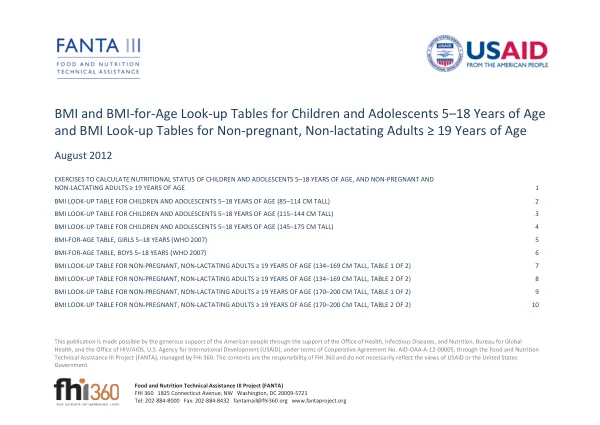
The tables provide a method for determining BMI and BMI-for-Age for children and adolescents aged 5–18 years and non-pregnant, non-lactating adults aged 19 years and above. The tables are organized by height and weight ranges, with BMI values calculated for each combination. For children and adolescents, the tables are divided into four height ranges: 85–114 cm, 115–144 cm, 145–175 cm, and 175 cm and above. For non-pregnant, non-lactating adults, the tables are divided into three height ranges: 134–169 cm, 170–200 cm, and 201 cm and above. The BMI Look-up Table for Children and Adolescents 5–18 Years of Age (85–114 cm tall) is a grid-based table that lists BMI values for children and adolescents within the specified height range. The table is organized with height values on the left and weight values at the bottom. The BMI value is determined by finding the intersection of the height and weight values. The BMI-for-Age Table, Girls 5-18 Years (WHO 2007) and the BMI-for-Age Table, Boys 5-18 Years (WHO 2007) are used to determine BMI-for-Age for children and adolescents. The tables are organized by age and BMI values, with the BMI-for-Age value determined by tracing a line across from the age value to the BMI value. The tables provide a method for determining nutritional status, with BMI values categorized as underweight, normal weight, overweight, and obese. The BMI-for-Age tables provide a method for determining nutritional status in relation to age, with values categorized as underweight, normal weight, overweight, and obese. The tables are used to calculate nutritional status for children and adolescents aged 5–18 years and non-pregnant, non-lactating adults aged 19 years and above. The tables are organized by height and weight ranges, with BMI values calculated for each combination. The BMI-for-Age tables provide a method for determining nutritional status in relation to age. The tables are used in conjunction with the BMI Look-up Table for Children and Adolescents 5–18 Years of Age and the BMI Look-up Table for Non-pregnant, Non-lactating Adults ≥ 19 Years of Age to determine nutritional status. The tables are organized by height and weight ranges, with BMI values calculated for each combination.
Related documents