USAID DEC
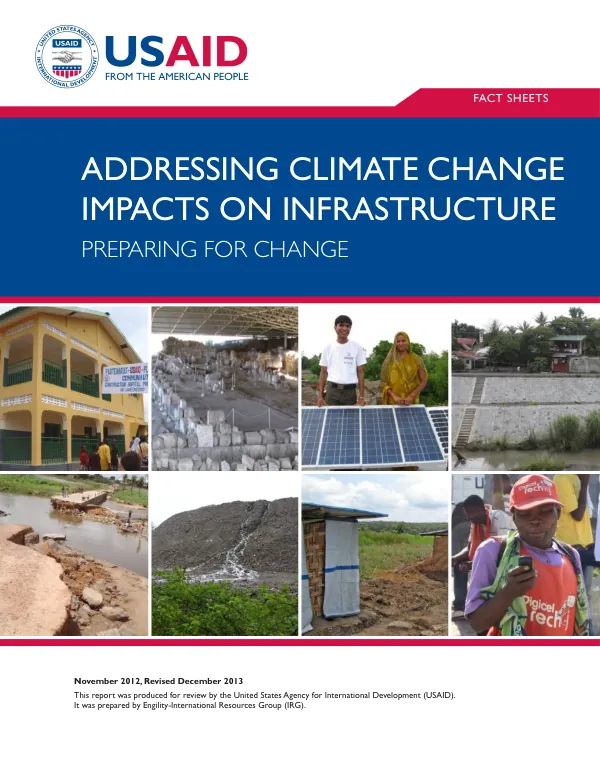
Addressing Climate Change Impacts on Infrastructure: Preparing for Change - Potable Water Systems
Sign inUSAID
Addressing Climate Change Impacts on Infrastructure: Preparing for Change - Potable Water Systems
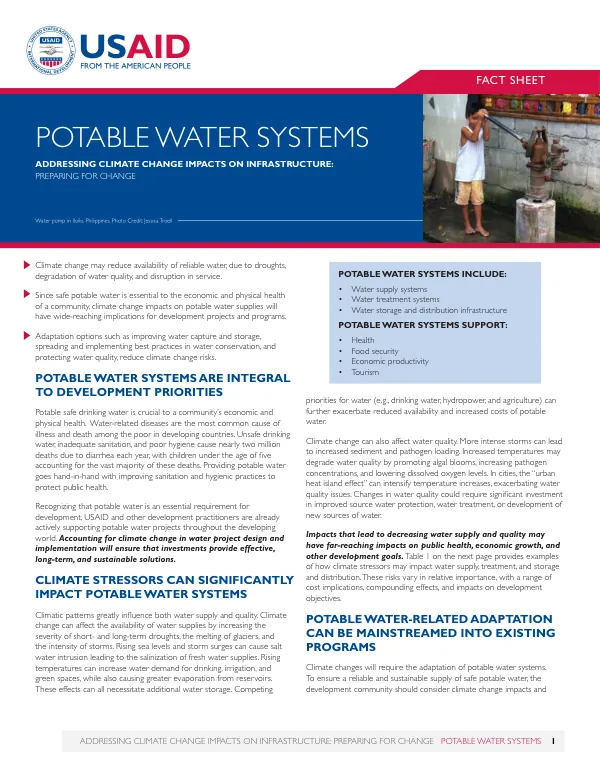
Climate change may reduce the availability of reliable water due to droughts, degradation of water quality, and disruption in service.
2012 · 3 pages
Sign in to readA free account is required to download.
Abstract
Safe potable water is essential to the economic and physical health of a community, and climate change impacts on potable water supplies will have wide-reaching implications for development projects and programs. Adaptation options such as improving water capture and storage, spreading and implementing best practices in water conservation, and protecting water quality can reduce climate change risks. Potable safe drinking water is crucial to a community's economic and physical health. Water-related diseases are the most common cause of illness and death among the poor in developing countries. Unsafe drinking water, inadequate sanitation, and poor hygiene cause nearly two million deaths due to diarrhea each year, with children under the age of five accounting for the vast majority of these deaths. Providing potable water goes hand-in-hand with improving sanitation and hygienic practices to protect public health. Climate change can affect the availability of water supplies by increasing the severity of short- and long-term droughts, the melting of glaciers, and the intensity of storms. Rising sea levels and storm surges can cause saltwater intrusion leading to the salinization of fresh water supplies. Rising temperatures can increase water demand for drinking, irrigation, and green spaces, while also causing greater evaporation from reservoirs. These effects can all necessitate additional water storage. Competing priorities for water can further exacerbate reduced availability and increased costs of potable water. Climate change can also affect water quality. More intense storms can lead to increased sediment and pathogen loading. Increased temperatures may degrade water quality by promoting algal blooms, increasing pathogen concentrations, and lowering dissolved oxygen levels. In cities, the "urban heat island effect" can intensify temperature increases, exacerbating water quality issues. Changes in water quality could require significant investment in improved source water protection, water treatment, or development of new sources of water. Impacts that lead to decreasing water supply and quality may have far-reaching impacts on public health, economic growth, and other development goals. To ensure a reliable and sustainable supply of safe potable water, the development community should consider climate change impacts and adaptation in existing programs and projects. Adaptation may involve additional investment, improved operation and maintenance, and long-term planning. Decision-makers need to consider four key factors when prioritizing adaptation efforts: criticality, likelihood, consequences, and resources available. There is a range of adaptation options to increase the availability of water, to ensure water quality, and to protect and harden water treatment facilities. Both hard and soft responses exist. Hard options refer to structural changes such as constructing reservoirs, holding ponds, rainwater harvesting systems, and water treatment facilities. Soft options refer to management, operational, or policy changes such as changes in maintenance activities, changes in land protection or zoning practices to protect water quality, and training and education for water conservation. By intentionally integrating climate information into program development and investment decisions, USAID and other development practitioners can avoid maladaptive projects. An integrated, climate-resistant approach will maintain value over the long term. This approach is aligned with the Climate-Resilient Development (CRD) Framework.