USAID
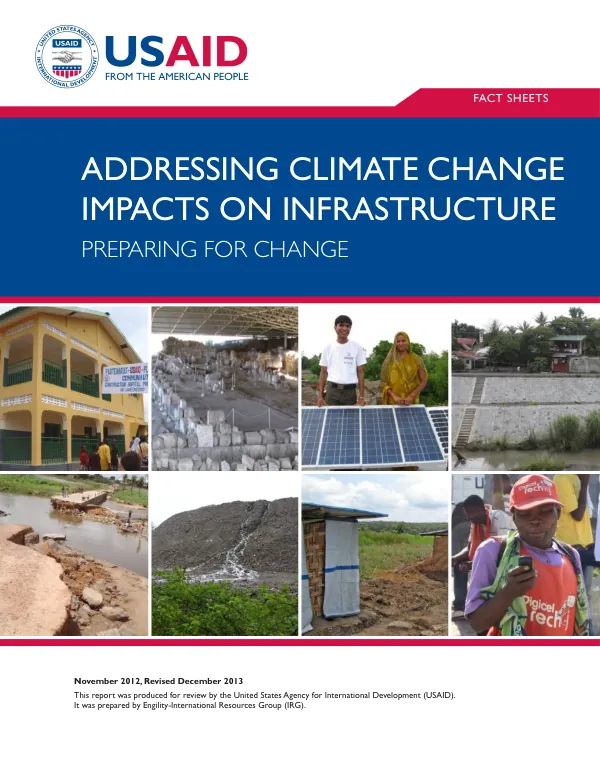
Addressing Climate Change Impacts on Infrastructure: Preparing for Change
Infrastructure plays a critical role in development programs, serving as the foundation for economic, social, and cultural life of communities and countries.
2012 · 50 pages
Sign in to readA free account is required to download.
Abstract
Infrastructure encompasses a variety of constructed networks and individual structures, including transportation systems, water and waste systems, energy, and communications networks. These systems are essential for the transport of goods and people, provision of energy, clean water, commerce, communication, and emergency response to disasters. Infrastructure investment is often an integral component of a broader development effort, such as food security, agriculture, or public health. For example, the Feed the Future (FTF) program relies on a range of infrastructure services to enable agriculture development, including transportation networks, reliable water supplies, and energy networks. These infrastructure systems are fundamental to the ability of FTF to advance food security. Infrastructure systems are built to last, with long lifetimes that span over 20, 50, even 100 years. However, they are uniquely affected by climate change due to their long service life and significant financial commitments. As a result, it is critical that infrastructure decisions are made with consideration for climate change impacts over time. The longer the anticipated service life of infrastructure, the more important it is to incorporate climate change considerations into planning and design. Infrastructure is also interdependent, with disruptions in one system having cascading impacts throughout a region. For example, a disruption in electrical power can affect telecommunications systems, which in turn operate water management systems. The introduction of "smart" technologies has increased the interdependence of infrastructure, making it even more critical to use a systems planning approach to avoid and prepare for disruptions, including those due to climate change. Climate change impacts on infrastructure can be significant, with rising temperatures, changing precipitation patterns, and increased frequency of extreme weather events affecting the performance and lifespan of infrastructure assets. For example, sea-level rise can damage coastal infrastructure, while more frequent and intense storms can damage transportation systems and buildings. Understanding the potential impacts of climate change on infrastructure is essential for developing effective adaptation strategies and ensuring the resilience of infrastructure systems. The impacts of climate change on infrastructure can be categorized into several types, including physical damage, increased maintenance costs, and changes in service life. Physical damage can result from extreme weather events, such as hurricanes, floods, and wildfires, while increased maintenance costs can result from the need to repair or replace damaged infrastructure. Changes in service life can result from the degradation of infrastructure materials or the increased frequency of extreme weather events. Adaptive management approaches can help decision-makers understand vulnerability, assess climate impacts, identify priorities, and take appropriate adaptation actions. This involves ongoing monitoring and evaluation of infrastructure performance, as well as the development of strategies to mitigate the impacts of climate change. By incorporating climate change considerations into infrastructure planning and design, decision-makers can ensure the resilience of infrastructure systems and minimize the risks associated with climate change impacts.
Related documents