USAID DEC
Addressing Gender-Based Violence Included in Minimum Package of HIV Services for Female Sex Workers in Luanda
Sign inFHI 360
Addressing Gender-Based Violence Included in Minimum Package of HIV Services for Female Sex Workers in Luanda
The integration of gender-based violence (GBV) prevention services with HIV prevention and testing services under the LINKAGES Project in Angola began in 2017.
2019 · 4 pages
Sign in to readA free account is required to download.
Abstract
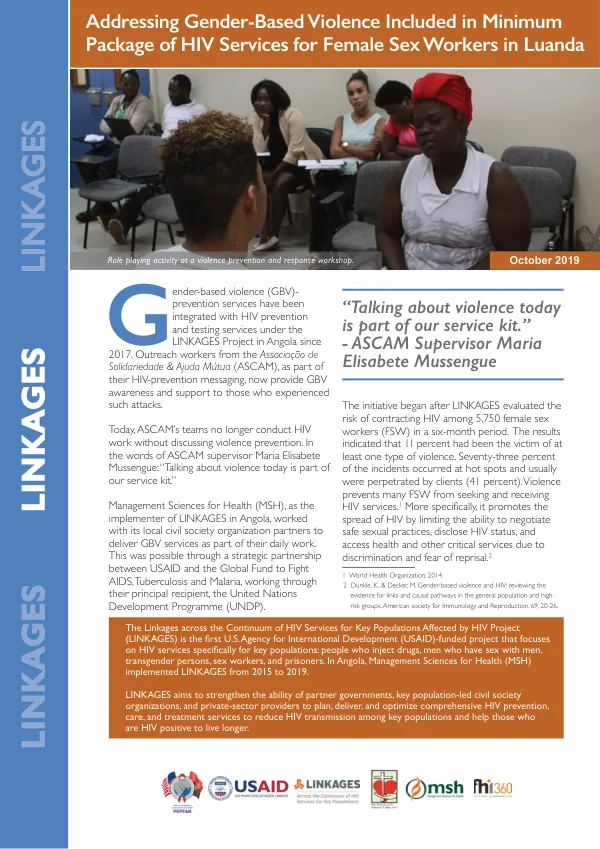
Outreach workers from the Associação de Solidariedade & Ajuda Mútua (ASCAM) now provide GBV awareness and support to female sex workers (FSW) who have experienced violence, as part of their HIV-prevention messaging. ASCAM's teams no longer conduct HIV work without discussing violence prevention, with supervisor Maria Elisabete Mussengue stating, "Talking about violence today is part of our service kit." The initiative was made possible through a strategic partnership between USAID and the Global Fund to Fight AIDS, Tuberculosis and Malaria, working through the United Nations Development Programme (UNDP). The partnership aimed to strengthen the ability of partner governments, key population-led civil society organizations, and private-sector providers to plan, deliver, and optimize comprehensive HIV prevention, care, and treatment services to reduce HIV transmission among key populations and help those who are HIV positive to live longer. LINKAGES evaluated the risk of contracting HIV among 5,750 FSW in a six-month period, with results indicating that 11 percent had been the victim of at least one type of violence. Seventy-three percent of the incidents occurred at hot spots and were perpetrated by clients (41 percent). Violence prevents many FSW from seeking and receiving HIV services, promoting the spread of HIV by limiting the ability to negotiate safe sexual practices, disclose HIV status, and access health and other critical services due to discrimination and fear of reprisal. ASCAM outreach teams received training on the link between HIV and violence among key populations, social gender norms, GBV, violence screening, communication, and self-care. Since then, 18 ASCAM peer educators and 18 HIV lay counselors have included these topics in their HIV outreach work. At first, ASCAM peer educators and lay counselors hesitated to discuss violence prevention and provide psychosocial support to victims, thinking it would interfere with their HIV-prevention work and increase their workload. However, after three months of integrating these services, they realized that talking about violence helps raise awareness about HIV and vice versa. The key to the program's success is providing knowledge about GBV, establishing a trusting bond with the sex workers, and offering psychosocial support when FSWs share reports of assaults. Additionally, often peer educators end up seeking support for themselves as well because many have also suffered violence. Some peer educators have taken their work beyond providing their standard services, intervening when seeing violence in the community. Between 2017 and 2019, a total of 24,975 FSW had been sensitized, and 355 cases of violence, mainly physical violence (52 percent), had been identified and referred to weekly support and empowerment group meetings, Mulheres Abençoadas (Blessed Women), that ASCAM and MSH created in 2017 under the auspices of LINKAGES and the Global Fund/UNDP.
Related documents