USAID DEC
Creating Opportunities out of Challenges: How #EAWA Togo Is Successfully Retaining People Living with HIV on Antiretroviral Therapy Despite Disruptions from COVID-19
Sign inFHI 360
Creating Opportunities out of Challenges: How #EAWA Togo Is Successfully Retaining People Living with HIV on Antiretroviral Therapy Despite Disruptions from COVID-19
The Ending AIDS in West Africa project, known as #EAWA, is a five-year cooperative agreement funded by the U.S.
2020 · 6 pages
Sign in to readA free account is required to download.
Abstract
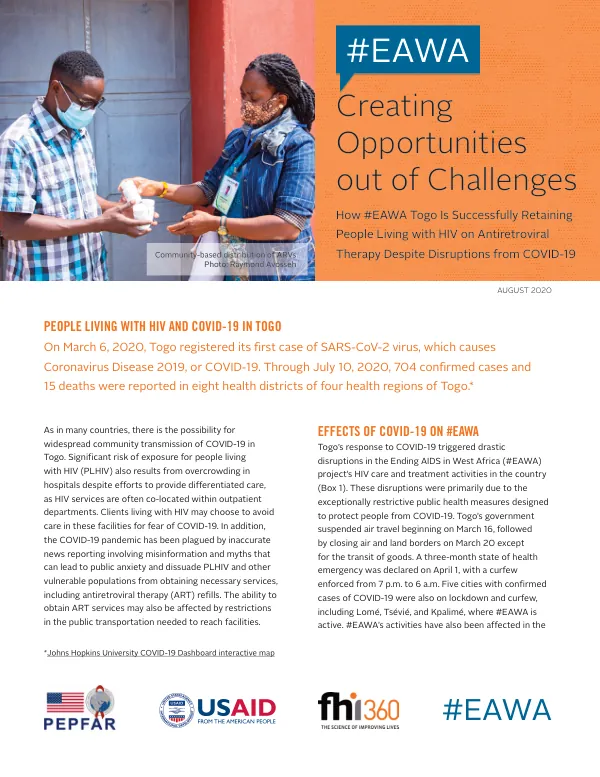
Agency for International Development (USAID)/West Africa and the U.S. President's Emergency Plan for AIDS Relief (PEPFAR) and led by FHI 360. The project's main goal is to accelerate progress toward the UNAIDS 95-95-95 targets for ending the AIDS epidemic by 2030 in the West Africa region. The targets are to achieve 95% diagnosed, 95% on treatment, and 95% virally suppressed by 2030. #EAWA currently operates in Togo and Burkina Faso and focuses on improving access to HIV prevention, care, and treatment services for sex workers, men who have sex with men, and people living with HIV. In Togo, the COVID-19 pandemic triggered drastic disruptions in #EAWA's HIV care and treatment activities. The disruptions were primarily due to the exceptionally restrictive public health measures designed to protect people from COVID-19. Togo's government suspended air travel, closed air and land borders, and declared a three-month state of health emergency. The night curfew ended on June 8, but face masks continue to be obligatory. The disruptions posed significant risks for both beneficiaries and providers, making it challenging to continue providing services as usual. To mitigate the adverse effects of COVID-19, #EAWA initiated three strategies to create stable opportunities for people living with HIV (PLHIV) to maintain antiretroviral therapy (ART) adherence. The first strategy was to accelerate three-month multi-month dispensing (MMD) of ART refills. Prior to the pandemic, MMD was given exclusively to people already stable on ART. However, during COVID-19, program data show that 61% of all those on treatment who presented to renew their antiretrovirals (ARVs) at project sites from April 13 to May 10, 2020, were receiving MMD. The second strategy was to call clients one week before appointments as reminders and to arrange safe ART refills. Of the 2,111 PLHIV eligible for ART refills whom they contacted by telephone, 93.5% came for their refills. The third strategy was to decentralize ART dispensation to the community through community-based or home delivery. #EAWA's adaptation of its practices to COVID-19 conditions has resulted in better organization and more contact with clients by phone and online, including providing individual and/or group counseling on treatment adherence through WhatsApp. Staff have also accelerated the search, mostly by telephone, for people who do not show up for their appointments, are absent from treatment because they no longer seek appointments, or may be lost to follow-up. Efforts are continuing to expand ART dispensation through community-based or home delivery. Ensuring safe delivery of HIV services at health facilities is also crucial for promoting retention on ART during COVID-19. This requires attention to hand washing, use of hand sanitizer and masks, infection prevention and control measures, and modified service delivery to achieve social distancing and crowd control.
Related documents