HUMANITY AND INCLUSION
Advancing Medical Care and Rehabilitation Education Project
The Advancing Medical Care and Rehabilitation Education Project was initiated to improve the quality of life for individuals with disabilities.
2021 · 1 pages
Sign in to readA free account is required to download.
Abstract
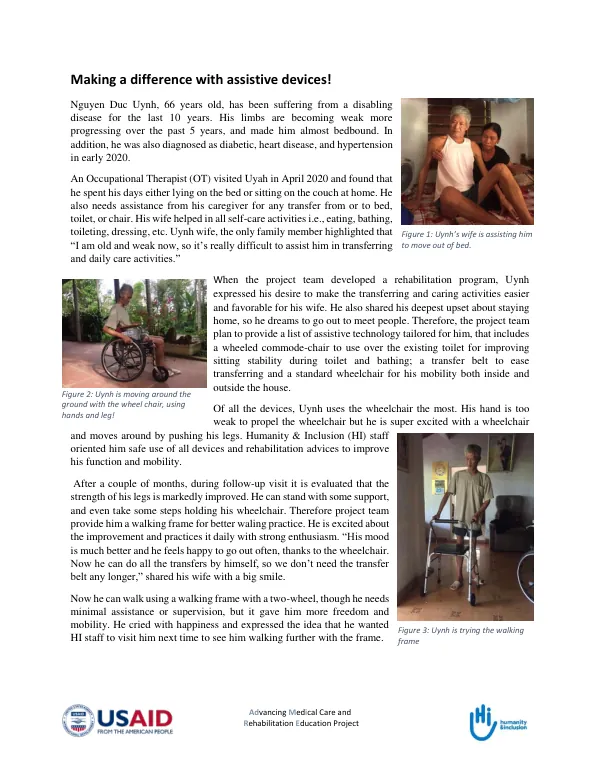
The project focused on providing assistive technology and rehabilitation services to individuals in need. One such individual was Nguyen Duc Uynh, a 66-year-old man who had been suffering from a disabling disease for 10 years. Uynh's condition had progressed significantly over the past five years, rendering him almost bedbound. He was also diagnosed with diabetes, heart disease, and hypertension in early 2020. An Occupational Therapist (OT) visited Uynh in April 2020 and assessed his needs. The OT found that Uynh relied heavily on his caregiver for daily activities, including transfers from or to bed, toilet, or chair. His wife, who was his primary caregiver, expressed difficulty in assisting him due to her own age and health limitations. Uynh's wife highlighted the challenges of caring for her husband, stating that it was "really difficult to assist him in transferring and daily care activities." The project team developed a rehabilitation program tailored to Uynh's needs. The program aimed to improve his mobility and independence. Uynh expressed his desire to make transferring and caring activities easier for his wife and to regain his ability to go out and interact with people. The project team provided Uynh with a list of assistive technology, including a wheeled commode-chair, a transfer belt, and a standard wheelchair. The wheelchair was the most frequently used device, allowing Uynh to move around both inside and outside the house. Humanity & Inclusion (HI) staff provided Uynh with training on the safe use of the assistive devices and offered rehabilitation advice to improve his function and mobility. After a couple of months, Uynh's follow-up visit revealed significant improvements in his leg strength. He was able to stand with some support and even take a few steps while holding onto his wheelchair. The project team provided him with a walking frame to facilitate further improvement in his mobility. Uynh's wife reported that he was able to perform transfers independently, rendering the transfer belt unnecessary.