USAID DEC
Advancing the Antimicrobial Drug Quality Agenda through Coalition Building: Lessons from AMR Response
Sign inECUMENICAL PHARMACEUTICAL NETWORK
Advancing the Antimicrobial Drug Quality Agenda through Coalition Building: Lessons from AMR Response
The antimicrobial drug quality agenda has been advanced through coalition building, as evident in the AMR response monitoring and improving medicines quality through AMR national action plans.
2018 · 15 pages
Sign in to readA free account is required to download.
Abstract
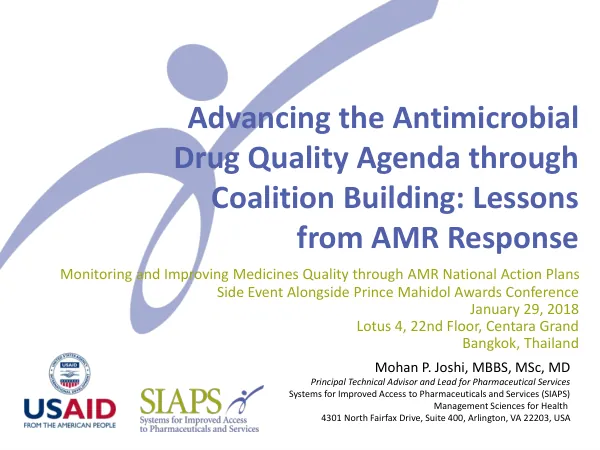
This initiative was presented at the Prince Mahidol Awards Conference on January 29, 2018, in Bangkok, Thailand. The presentation highlighted the importance of stakeholders in addressing substandard and falsified medicines. Key stakeholders identified in the presentation include national regulatory authorities, national quality control labs, national PV centers, healthcare providers, professional associations, media, patients, and patient interest groups. Additionally, procurement agencies, customs, police, Interpol, public/private health facilities, academia, and research institutions were also recognized as essential stakeholders. International organizations such as WHO, donors, NGOs, INGOs, and relief agencies, as well as the pharma industry and public health programs, were also acknowledged as critical players in addressing the issue of substandard and falsified medicines. Coalitions have been identified as a crucial component in improving the quality of medicines, including antimicrobials. The benefits of coalitions include a common vision, improved communication, and less duplication of efforts. Coalitions also facilitate the sharing of expertise, experience, best practices, lessons learned, and resources. Furthermore, coalitions can increase awareness, motivation, and engagement of nonspecialists, such as policymakers, patient groups, and journalists, and strengthen advocacy and evidence for garnering wide support and funding for medicine quality. Local coalitions for medicine quality have been established to address the issue of substandard and falsified medicines. These coalitions aim to improve access to quality medicines, strengthen governance for medicine quality, and increase technical capacity for quality medicines. The Prevent, Detect, and Respond framework is a key component of these coalitions, which focuses on preventing the demand for substandard and falsified medicines, detecting and reporting these issues, and responding to protect public health and prevent recurrence. Subcoalitions within larger coalitions can spearhead specific interventions, such as reforming health professional pre- and in-service curricula to include medicine quality topics, training and equipping journalists for reporting on medicine quality issues, and addressing the challenge of falsified medicines. The SIAPS-supported approach focuses on catalyzing coalitions and advocacy by local stakeholders to build realistic strategies to contain AMR. The USAID-funded SIAPS Program has helped build capacity to generate coalitions to fight AMR at the country and regional levels in Africa. The USAID/SIAPS-supported approach to building coalitions against AMR involves identifying key issues and players, building and expanding coalitions, mobilizing support and identifying a local champion group, understanding the local situation and generating feasible actions, and monitoring and evaluating the process. A coalition-building guidebook has been developed to jump-start the process, which includes key components, advocacy and coalition-building guidelines, practical implementation examples, and user-friendly implementation tools and templates.