CENTER FOR EDUCATIONAL DEVELOPMENT
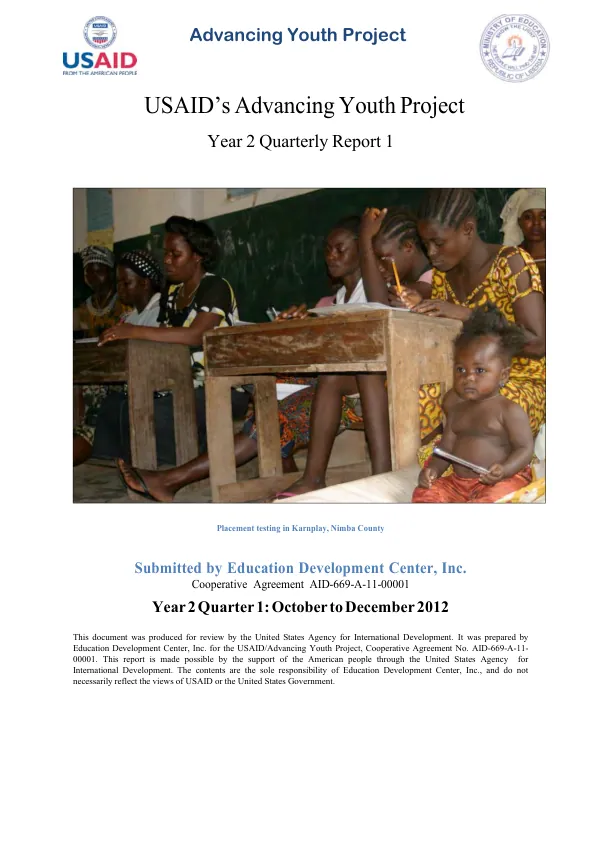
Advancing Youth Project Year 2 Quarterly Report 1: October - December 2012
The Advancing Youth Project is a USAID-funded initiative aimed at improving education and livelihood opportunities for out-of-school and over-age youth in Liberia.
2012 · 203 pages
Sign in to readA free account is required to download.
Abstract
The project focuses on increasing institutional capacity to plan, budget, and deliver Alternative Basic Education (ABE) for youth, as well as providing access to relevant basic education and skills training. Institutional capacity strengthening is a key component of the project, with the Ministry of Education (MoE) playing a central role. The MoE has been able to set national ABE policies, prepare annual implementation plans and budgets, and train, support, and monitor ABE teachers. This has been achieved through capacity strengthening at national and county levels, coordination with other government partners, and the development of ABE committees' terms of reference. The project has also focused on developing the capacity of local institutions to partner with the MoE in delivering quality ABE instruction. This has involved collaboration with NGOs, the Liberia International NGO Education Sector Coordination Meeting, and the Peace Corps. Additionally, a comprehensive ABE curriculum has been developed and implemented, including level 2 materials, workbooks, and manuals. To increase access to relevant basic education and skills training, the project has implemented strategies for recruiting and retaining youth, particularly young women. This has included community-based recruitment, the establishment of school-based youth clubs, and the development of manuals and guidelines for youth development training. ABE facilitators have also been trained to effectively teach all levels of the ABE curriculum, and students have shown improvements in literacy, numeracy, work readiness, health, and life skills. The project has also established national and county-level public-private alliances for youth education and employment, providing increased work-based learning, skills training, and entrepreneurship opportunities for targeted youth. This has involved labor market assessments, county alliances, and public-private partnerships. The project's goal is to provide sustainable livelihood pathways for targeted youth, enabling them to access better education and employment opportunities.