FHI 360
Advocacy to Reduce Malnutrition: Using PROFILES and Nutrition Costing
The Food and Nutrition Technical Assistance III Project (FANTA) is a platform for creating movement toward greater political and social commitment to nutrition in a country.
2018 · 4 pages
Sign in to readA free account is required to download.
Abstract
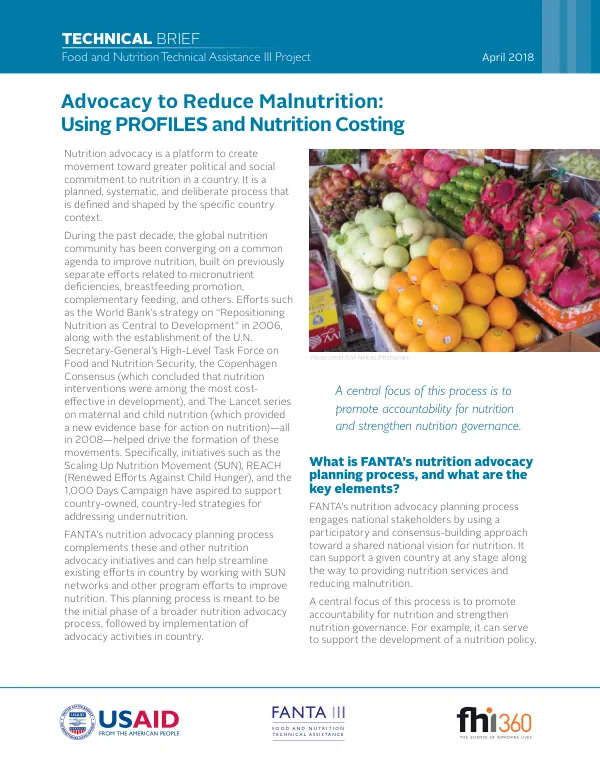
Nutrition advocacy is a planned, systematic, and deliberate process defined and shaped by the specific country context. The global nutrition community has been converging on a common agenda to improve nutrition, built on previously separate efforts related to micronutrient deficiencies, breastfeeding promotion, complementary feeding, and others. During the past decade, various initiatives have driven the formation of these movements, including the World Bank's strategy on "Repositioning Nutrition as Central to Development" in 2006, the establishment of the U.N. Secretary-General's High-Level Task Force on Food and Nutrition Security, the Copenhagen Consensus, and The Lancet series on maternal and child nutrition. Initiatives such as the Scaling Up Nutrition Movement (SUN), REACH (Renewed Efforts Against Child Hunger), and the 1,000 Days Campaign have aspired to support country-owned, country-led strategies for addressing undernutrition. FANTA's nutrition advocacy planning process complements these and other nutrition advocacy initiatives by working with SUN networks and other program efforts to improve nutrition. This planning process is the initial phase of a broader nutrition advocacy process, followed by implementation of advocacy activities in country. A central focus of this process is to promote accountability for nutrition and strengthen nutrition governance. The FANTA nutrition advocacy planning process engages national stakeholders by using a participatory and consensus-building approach toward a shared national vision for nutrition. It can support a given country at any stage along the way to providing nutrition services and reducing malnutrition. A central focus of this process is to promote accountability for nutrition and strengthen nutrition governance. The three key elements of FANTA's nutrition advocacy planning process are: Nutrition Advocacy Plan and Material Development, PROFILES, and Nutrition Costing. Nutrition Advocacy Plan and Material Development involves developing a plan to identify key audiences to be targeted by nutrition advocacy and determine a specific call to action for each. This plan lays out how to conduct nutrition advocacy in a systematic and coordinated way with all partners in country. PROFILES is a spreadsheet-based nutrition advocacy tool used to calculate consequences if malnutrition does not improve or change over a defined time period and the benefits of improved nutrition over the same time period. PROFILES estimates are based on reduction in the prevalence of several nutrition problems, such as iron deficiency anemia, low birth weight, vitamin A deficiency, iodine deficiency, suboptimal breastfeeding practices, and childhood stunting, underweight, and wasting. Nutrition Costing estimates the costs of implementing a comprehensive set of nutrition programs or interventions in a country or prioritized geographic area over a specific time period. Nutrition Costing is developed in country, considering the country-specific context, and is the result of a collaborative and participatory process during which multisectoral stakeholders define the assumptions on which nutrition costing is based. The FANTA nutrition advocacy planning process is helpful in situations where the prevalence of many forms of malnutrition is high, investment, commitment, governance, and accountability for nutrition are low, and nutrition services are fragmented and not holistic. Nutrition advocacy should be based on a sound understanding of the current country context for nutrition, systematic, planned, and deliberate, involving key stakeholders and targeting key audiences, part of a collaborative effort at the country level, and multisectoral. The process using PROFILES and nutrition costing promotes insight for action, consensus building and a shared vision for nutrition, accountability and goal setting for investment in nutrition across the life cycle, including services along a continuum of care for the prevention and treatment of malnutrition.
Related documents