USAID DEC
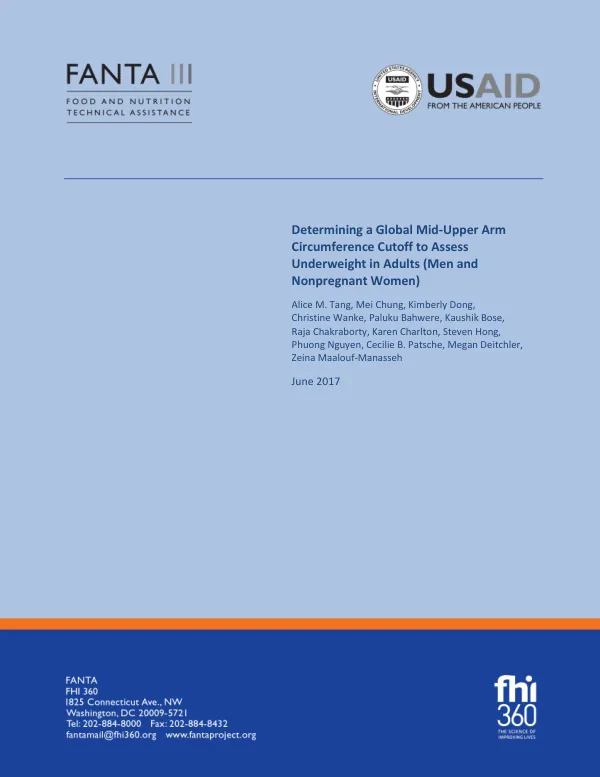
Determining a Global Mid-Upper Arm Circumference Cutoff to Assess Underweight in Adults (Men and Nonpregnant Women)
Sign inFHI 360
Determining a Global Mid-Upper Arm Circumference Cutoff to Assess Underweight in Adults (Men and Nonpregnant Women)
The mid-upper arm circumference (MUAC) cutoff for assessing underweight in adults has been a topic of interest globally.
2017 · 86 pages
Sign in to readA free account is required to download.
Abstract
Numerous studies have shown that MUAC correlates well with body mass index (BMI) in adult populations. However, globally applicable MUAC cutoffs have not been established to classify undernutrition among adults. Increasingly, MUAC is being used to assess nutritional status and to determine eligibility for services among adults, especially in people living with HIV and/or tuberculosis. A study conducted by Tufts University, in partnership with the Food and Nutrition Technical Assistance III Project (FANTA) funded by the U.S. Agency for International Development (USAID), undertook an individual participant data meta-analysis (IPDMA) to explore the sensitivity (SENS) and specificity (SPEC) of various MUAC cutoffs for identifying undernutrition among adults (men and nonpregnant women). Data were compiled from 17 studies of adults, including 7 from Africa, 5 from South Asia (India), 2 from Southeast Asia (Vietnam), 2 from North America (USA), and 1 from South America (Argentina). The study found that MUAC was highly discriminatory in its ability to distinguish nonpregnant adults with BMI <18.5 from those with BMI ≥18.5. Measures of SENS, SPEC, positive predictive value (PPV), and negative predictive value (NPV) for all MUAC cutoffs varied between individual studies. However, the area under the receiver operating characteristic curve (AUROCC) for all of the datasets combined was 0.92, which is considered to be in the excellent range. The study also performed various subgroup analyses to determine how MUAC cutoffs might differ in different settings and subpopulations. The results showed that the prevalence of low BMI (<18.5) ranged from approximately 5% or less in six studies to almost 90% in two studies. The mean age for all studies combined was 32.4±12.0 years, with ages ranging from 18 years to 91 years. More than two-thirds of participants in the combined dataset were female (69%). The study's findings suggest that MUAC cutoffs may be useful for identifying undernutrition among adults, particularly in people living with HIV and/or tuberculosis. However, further research is needed to establish globally applicable MUAC cutoffs for classifying undernutrition among adults. The study's results also highlight the importance of considering the heterogeneity between studies and the need for subgroup analyses to determine how MUAC cutoffs might differ in different settings and subpopulations. The study's methodology involved compiling data from 17 studies of adults and using a bivariate random effects model to jointly estimate SENS and SPEC while accounting for the heterogeneity between studies. The models included MUAC as the only independent variable predicting low BMI. The study's results provide valuable insights into the use of MUAC cutoffs for assessing undernutrition among adults and highlight the need for further research in this area.
Related documents