USAID DEC
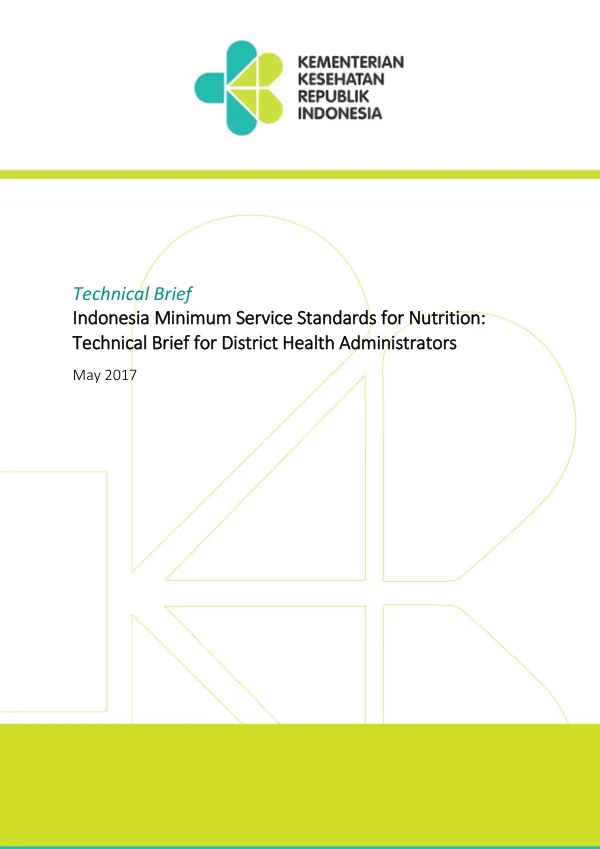
Indonesia Minimum Service Standards for Nutrition: Technical Brief for District Health Administrators
Sign inFHI 360
Indonesia Minimum Service Standards for Nutrition: Technical Brief for District Health Administrators
The Government of Indonesia has recently updated its Minimum Service Standards (MSS) for health services at the district level.
2017 · 33 pages
Sign in to readA free account is required to download.
Abstract
These standards define the services that must be provided to all citizens at primary and secondary health care centers, and are the mechanism by which district health administrators are held accountable for the target indicators set for each standard. Local governments are responsible for providing the infrastructure, equipment, human resources, and budget to reach 100% of the target indicators for each standard in the MSS. Improving nutrition is a key factor in achieving the target indicators for health indicators. Indonesia continues to experience widespread nutrition problems that affect key segments of the population, particularly adolescents, women, and children. The nutrition problems are hindering the country's progress towards achieving its health and economic development objectives. Both health and nutrition must be addressed to enable the country can achieve its national targets for health and nutrition. The MSS for health indicators are categorized into 12 population groups, including pregnant women, women during delivery, newborn babies, children under the age of 5 years, women of reproductive age, and others. District health administrators play a pivotal role in improving nutrition by developing food and nutrition action plans at the district level, ensuring adequate funding for nutrition, and providing in-service training on quality of services for health workers. Several policies, strategies, and plans have been put into place in Indonesia that serve as a framework for the MSS as they relate to nutrition. The Indonesia Health Law No. 36/2009 established nutrition development targets to achieve improved individual and community nutritional status. The Presidential Decree No. 42/2013 on National Movement to Accelerate Nutrition Improvement focuses on the first 1,000 days of a child's life and established longer-term nutrition targets in line with the World Health Assembly 2025 targets. The National Plan of Action on Food and Nutrition (2015-2019) outlines food and nutrition activities to improve the nutritional status of pregnant women and children up to 4 years of age. The plan focuses on nutrition interventions implemented through health services, including maternal nutrition, adolescent health, and behaviors related to water, sanitation, and hygiene. The MSS for nutrition is categorized into five categories, including pregnant women, women during delivery, newborn babies, children under the age of 5 years, and women of reproductive age. District health administrators are responsible for developing food and nutrition action plans at the district level, ensuring adequate funding for nutrition, and providing in-service training on quality of services for health workers. The MSS for nutrition focuses on improving the nutritional status of pregnant women, children under the age of 5 years, and women of reproductive age. The MSS also emphasizes the importance of addressing the contributing factors to stunting, wasting, overweight, and low birth weight, such as suboptimal infant and young child feeding, adolescent health, and maternal nutrition, and behaviors related to water, sanitation, and hygiene. The MSS for nutrition is a key framework for improving the nutritional status of the population in Indonesia. The MSS provides a clear direction for district health administrators to improve nutrition and improve the health outcomes of the population. The MSS also emphasizes the importance of addressing the contributing factors to stunting, wasting, overweight, and low birth weight, and provides guidance on services and interventions to meet the MSS for health indicators.