DELOITTE CONSULTING, LLP
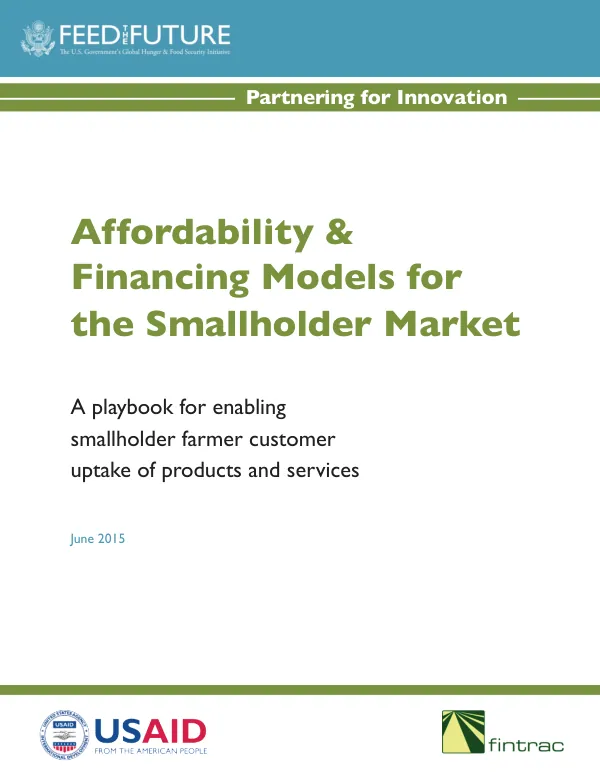
Affordability & Financing Models for the Smallholder Market
Smallholder farmers face significant barriers to accessing financing, with a global demand of $450 billion and local bank lending covering less than 3% of this need.
2015 · 25 pages
Sign in to readA free account is required to download.
Abstract
Traditional commercial lenders often decline to lend to smallholder farmers due to factors such as low financial literacy, limited collateral, and perceived high risk. As a result, businesses serving smallholder farmers must rely on innovative methods to enable customers to purchase products and services. Several affordability and financing strategies are available to companies to offer customers, including bundling and cross-subsidization, no-frills services, pay-per-use models, and leasing. These strategies can be coupled with product and service delivery to provide a comprehensive solution that increases customer adoption. This playbook aims to provide partners with an understanding of the variety and viability of these strategies, as well as examples of success stories and enablers that can increase the likelihood of success. The need for affordability and financing is driven by the fact that smallholder farmers want financing, with 91% of farmer respondents citing "input access and funding" as their top concern. The decision to pursue product affordability and financing depends on several factors, including an understanding of the customer, product or service being offered, company offering it, market context, and the details of the strategies themselves. If the price at which a company plans to sell its product or service is too high, creating a barrier to the customer, the company must offer customers affordability or financing options that will facilitate product adoption. Affordability and financing are distinct concepts, with affordability referring to decreasing the cost of a product or service, and financing referring to providing financial resources or an equivalent to acquire a good or the use of one. The approaches to implementing affordability and financing options differ, and in some cases, more than one strategy can be used in combination. Companies must evaluate which affordability and financing choice is optimal for their business model, taking into account the customer's needs, product or service being offered, and market context. The following strategies can be used to implement affordability and financing options: * Bundling and cross-subsidization: This involves offering a combination of products or services at a discounted price, or providing a free product or service in exchange for the purchase of another product or service. * No-frills services: This involves offering a basic version of a product or service at a lower price, with fewer features or services included. * Pay-per-use models: This involves charging customers for the use of a product or service, rather than requiring them to purchase it outright. * Leasing: This involves allowing customers to use a product or service for a set period of time, in exchange for a monthly or annual fee. Each of these strategies has its own advantages and disadvantages, and companies must carefully evaluate which one is best suited to their business model and customer needs. By offering affordability and financing options, companies can increase customer adoption and revenue, while also improving the lives of smallholder farmers.
Related documents