DELOITTE CONSULTING, LLP
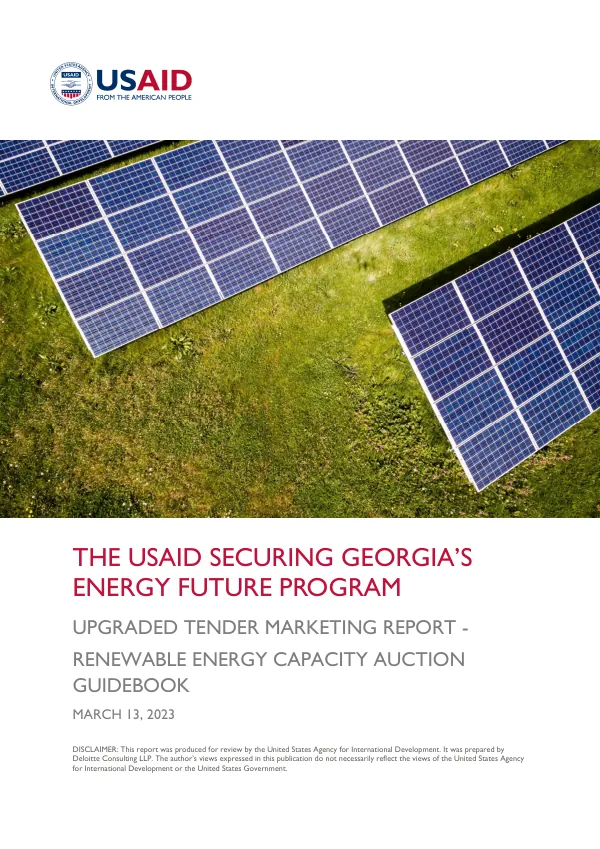
Renewable Energy Capacity Auction Guidebook
The USAID Securing Georgia's Energy Future Program aims to improve Georgia's energy security and reduce its susceptibility to malign influence.
2023 · 53 pages
Sign in to readA free account is required to download.
Abstract
The program's objective is to achieve sound long-term policymaking and governance, increase private-sector investment in indigenous renewable energy production, build the capacity of Georgian institutions to effectively manage domestic energy, and enhance energy sector resilience to cyber threats. The program will support the development of Georgia's energy sector into an open, regionally integrated, market-driven system capable of independently planning, financing, and implementing solutions to Georgia's energy challenges. The program's specific objectives include improving energy system planning, increasing investment to promote energy sector resilience, improving governance and operations of the Georgian energy market, and reducing cybersecurity vulnerabilities. To achieve these objectives, the program will establish, coordinate, and coordinate energy sector policy through approaches that improve planning capabilities. It will also support private engagement to assist Georgia in attracting energy sector investment, align Georgia's energy market with European Union directives, and build the capacity of Georgian energy sector institutions to operate in advanced market structures. The program will also focus on improving governance and operations of the Georgian energy market, broadening Georgia's regional energy integration and cross-border trade with Azerbaijan, Armenia, Turkey, and Turkey, and safeguarding the strategic segments of Georgia's energy sector and the country as a whole. Investments in energy resilience will be made through a clear sector goal process, a robust project pipeline, and attractive offerings to investors. The program will also support the development of a competitive procurement process, including the preparation of a report on upgraded tender marketing, which will provide guidance on public notices and support state institutions in upgraded tender marketing. The report is comprised of an introduction, executive summary, guidance, frequently asked questions, and annexes that provide additional information on the auction process, capacity auction rules, and other relevant details. The EU-Georgia Association Agreement and the Protocol on Accession of Georgia to the Energy Community Treaty have committed Georgia to transpose and implement the Energy Community acquis within a defined timeframe. This has led to various reforms in the Georgian energy sector, including the establishment of competitive and transparent energy markets. The program will support the development of a fully functioning, liquid energy market in Georgia, with a focus on increasing private-sector investment in renewable energy production. The program's activities will be implemented through a series of sub-tasks, including the design of competitive procurement, public awareness, and awareness-raising activities. The program will also provide technical assistance to Georgian institutions to support the development of a competitive procurement process and the implementation of the program's objectives. The program's expected outcomes include improved energy system planning, increased investment in energy sector resilience, improved governance and operations of the Georgian energy market, and reduced cybersecurity vulnerabilities. The program will also contribute to the development of a fully functioning, liquid energy market in Georgia, with a focus on increasing private-sector investment in renewable energy production. The program's expected outcomes include improved energy system planning, increased investment in energy