MANAGEMENT SCIENCES FOR HEALTH
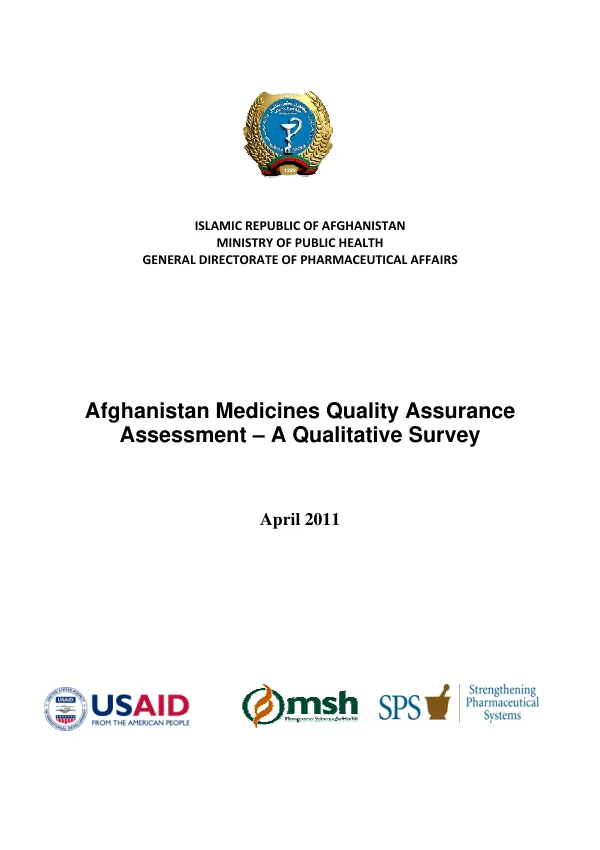
Afghanistan Medicines Quality Assurance Assessment – A Qualitative Survey
Afghanistan Medicines Quality Assurance Assessment – A Qualitative Survey The pharmaceutical sector in Afghanistan is a critical component of the country's healthcare system.
2011 · 81 pages
Sign in to readA free account is required to download.
Abstract
The General Directorate of Pharmaceutical Affairs, under the Ministry of Public Health, is responsible for ensuring the quality and safety of medicines available in the country. In 2011, a qualitative survey was conducted to assess the medicines quality assurance system in Afghanistan. The survey aimed to evaluate the regulatory framework, quality control laboratory testing, post-marketing surveillance activities, and the participation of development partners, NGOs, and government agencies in the medicines quality assurance system. The survey was conducted in collaboration with the Strengthening Pharmaceutical Systems (SPS) Program, which is supported by the United States Agency for International Development (USAID). The survey found that the regulatory authority in Afghanistan has established a national medicine law and policy, which provides a framework for the regulation of the pharmaceutical sector. However, the survey also identified several challenges in the implementation of these regulations, including inadequate resources and capacity within the regulatory authority. The survey also found that the quality control laboratory testing in Afghanistan is limited, with only a few laboratories equipped to conduct analytical testing of active pharmaceutical ingredients and finished pharmaceutical products. The survey recommended that the government invest in the development of a robust quality control laboratory testing system to ensure the safety and efficacy of medicines available in the country. In addition, the survey found that post-marketing surveillance activities in Afghanistan are limited, with no systematic monitoring of adverse events associated with the use of medicines. The survey recommended that the government establish a post-marketing surveillance system to monitor the safety of medicines and identify potential adverse events. The survey also highlighted the importance of collaboration between development partners, NGOs, and government agencies in the medicines quality assurance system. The survey found that development partners and NGOs have been providing technical assistance and support to the government in the development of the medicines quality assurance system. The survey concluded that the medicines quality assurance system in Afghanistan faces several challenges, including inadequate resources and capacity, limited quality control laboratory testing, and limited post-marketing surveillance activities. The survey recommended that the government invest in the development of a robust medicines quality assurance system to ensure the safety and efficacy of medicines available in the country. The survey also recommended that the government establish a national medicines quality assurance policy and develop a plan to implement the policy. The survey further recommended that the government invest in the development of a robust quality control laboratory testing system and establish a post-marketing surveillance system to monitor the safety of medicines. The survey was conducted by a team of experts from the SPS Program, in collaboration with the General Directorate of Pharmaceutical Affairs and other stakeholders. The survey used a qualitative approach, which involved conducting interviews with key stakeholders and collecting data through observations and document reviews. The survey found that the medicines quality assurance system in Afghanistan is critical to ensuring the safety and efficacy of medicines available in the country. The survey recommended that the government invest in the development of a robust medicines quality assurance system to ensure the safety and efficacy of medicines available in the country. The survey was conducted in April 2011, and the findings and recommendations of the survey are presented in this report. The report provides an overview of the medicines quality assurance system in Afghanistan, including the regulatory framework, quality control laboratory testing, post-marketing surveillance activities, and the participation of development partners, NGOs, and government agencies in the medicines quality assurance system. The report also presents the findings and recommendations of the survey, which are based on the data collected through the survey. The report provides an overview of the challenges facing the medicines quality assurance system in Afghanistan and recommends strategies for addressing these challenges. The report is intended to provide information to stakeholders, including the government, development partners, NGOs, and the private sector, on the medicines quality assurance system in Afghanistan. The report provides an overview of the system and highlights the challenges facing the system, as well as recommendations for addressing these challenges. The report is based on the data collected through the survey, which was conducted in April 2011. The survey used a qualitative approach, which involved conducting interviews with key stakeholders and collecting data through observations and document reviews. The report provides an overview of the medicines quality assurance system in Afghanistan, including the regulatory framework, quality control laboratory testing, post-marketing surveillance activities, and the participation of development partners, NGOs, and government agencies in the medicines quality assurance system. The report also presents the findings and recommendations of the survey, which are based on the data collected through the survey. The report provides an