USAID DEC
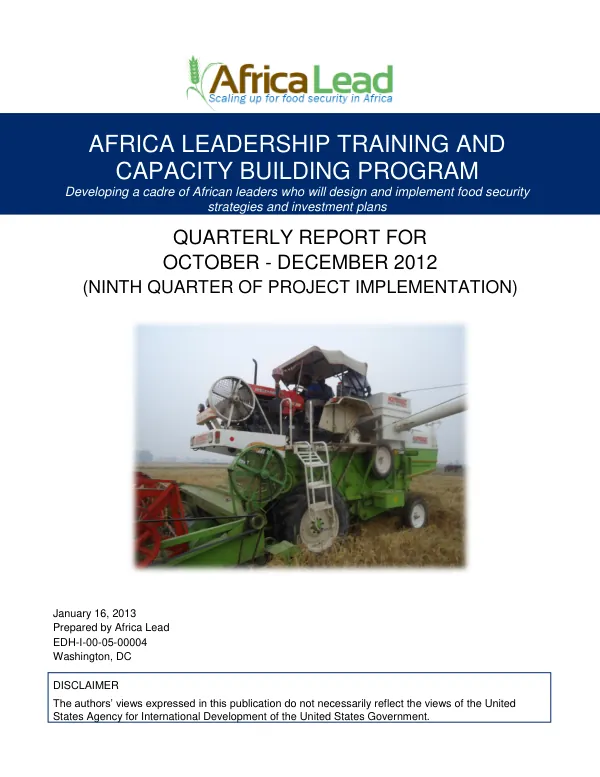
Africa Leadership Training and Capacity Building Program: Quarterly Report for October - December 2012 (Ninth Quarter of Project Implementation)
Sign inDAI
Africa Leadership Training and Capacity Building Program: Quarterly Report for October - December 2012 (Ninth Quarter of Project Implementation)
Africa Lead, the Africa Leadership Training and Capacity Building Program, was initially a two-year task order under the RAISE Plus Indefinite Quantity Contract (IQC) mechanism, designed to run from September 20, 2010 to September 30, 2012, with a budget ceiling of $21,332,381.
2013 · 34 pages
Sign in to readA free account is required to download.
Abstract
As of a September 30, 2012 contract modification, the Program was extended for one year (through September 2013) and the ceiling was raised by $4,850,000 to $26,182,381. Africa Lead is being implemented by lead RAISE Plus IQC holder, DAI, supported by Management Systems International (MSI), Winrock International, Training Resources Group (TRG), ECIAfrica Consulting (Pty) Ltd., and Michigan State University (MSU). From the beginning of the Program until July 31, 2012, Africa Lead was implemented through three regional programs: East and Southern Africa, West Africa, and Central Africa. The Program's primary objective is to develop a cadre of African leaders who will design and implement food security strategies and investment plans. To achieve this goal, Africa Lead provides leadership training to African food security leaders, supports short courses, workshops, conferences, and partnerships on innovative learning experiences, and conducts institutional capacity needs assessments to guide further training and capacity building. At the continental level, Africa Lead has been implementing various activities to support the development of African leaders. Task One of the Program involves the provision of leadership training to African food security leaders, with a focus on developing and rolling out a 5-day leadership training workshop. Module 1 of this task involves the development and roll-out of a 5-day leadership training workshop, while Module 2 focuses on an intensified 4-day leadership training workshop for food security champions. Task Two of the Program supports short courses, workshops, conferences, and partnerships on innovative learning experiences. Activity 2.1 involves building and developing training partnerships with specialized institutions, while Activity 2.3 supports the Champions for Change Networks. Task Three of the Program involves conducting institutional capacity needs assessments to guide further training and capacity building, with Activity 3.1 supporting the conduct of capacity needs assessments. In the East and Southern Africa region, Africa Lead has been implementing various activities to support the development of African leaders. Task One of the Program involves the provision of leadership training to African food security leaders, with a focus on developing and rolling out a 1-day leadership training workshop. Task Two of the Program supports short courses, workshops, conferences, and partnerships on innovative learning experiences, with Activity 2.1 involving building and developing training partnerships with specialized institutions. In the West Africa region, Africa Lead has been implementing various activities to support the development of African leaders. Task One of the Program involves the provision of leadership training to African food security leaders, while Task Two supports short courses, workshops, conferences, and partnerships on innovative learning experiences. Activity 2.1 involves an agribusiness leadership program, B2B exchanges, while Activity 2.2 focuses on customized training courses for West Africa regional organizations. Africa Lead's performance monitoring involves the development of data collection forms/instruments, with a focus on tracking indicators related to the Program's objectives. The Program also conducts lessons learned research to identify best practices and areas for improvement. The Africa Lead Results Framework and Indicator Tracking Sheet provide a comprehensive overview of the Program's performance and progress towards its objectives.