USAID
Africa Synergies in Urbanization
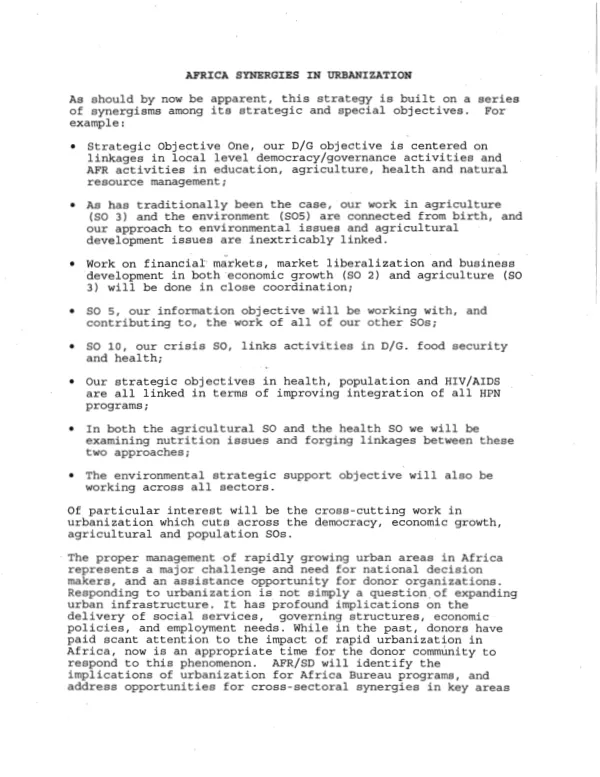
Africa Synergies in Urbanization is a strategy built on a series of synergisms among its strategic and special objectives.
2016 · 4 pages
Sign in to readA free account is required to download.
Abstract
Strategic Objective One centers on linkages in local level democracy/governance activities and AFR activities in education, agriculture, health, and natural resource management. Work on agriculture and the environment are connected and inextricably linked, with a focus on improving integration of all HPN programs. The strategy also emphasizes the importance of responding to urbanization, which has profound implications on the delivery of social services, governing structures, economic policies, and employment needs. Urban areas in Africa are a growing concern for national policy makers and donor agencies, with demographic trends suggesting a reconsideration of national policies and development assistance is necessary. The United Nations estimates that the percentage of urban population will increase from 33.8% in 1994 to 53.8% in 2025. Policies redressing the degree of urban bias in African economic strategies may slow down the rate of internal migration, but many countries will experience a near doubling of their urban population in this period. For example, Kenya's urban population will grow from 27% to 52%. The high rate of population growth is accompanied by a breakdown of traditional networks, kinship patterns, and leadership mechanisms, leading to social breakdown and increased dependence on public governing institutions. However, the disappearance of traditional structures has led to the formation of surrogate forms of ethnic groupings and traditional structures, which constitute an opportunity that has not been fully appreciated. The primary cities have benefited from high levels of infrastructure investment, but they are poorly equipped to manage mushrooming squatter and low-income areas that receive much of the incoming migration. With reductions in central government resources for infrastructure investment, the mobilization of local resources and the development of innovative service delivery mechanisms is essential. The problem is more acute in secondary cities, also growing rapidly, where the physical, social, and administrative infrastructure is even less developed. Inadequate infrastructure in squatter settlements and other forms of unplanned urban growth leads to poor environmental conditions that have a severe impact on health and productivity. The relationship between urbanization and the delivery of services, such as health and sanitation, is relatively well understood, but the implications for other services, such as primary care, may be less documented. Most countries in sub-Saharan Africa are paying renewed attention to decentralization policies, with subnational or local government systems existing in some form for many decades. Strengthening service delivery at the local level is intended to more accurately reflect the preferences of service consumers and to make service agencies more accountable. However, implementing decentralization by creating effective local units remains problematic, with local capacities remaining weak and the real willingness of central authorities to relinquish their authority yet to be proven in many countries. USAID and other donors have gained substantial multi-disciplinary field experience in a number of sectors that is directly relevant to tackling the problems of urban management in Africa. Some of the issues in Africa are not unique to urban areas per se, but urban areas need focused, consolidated solutions. Lessons learned through projects such as the West Africa Municipal Management Training Program and the Local Government Support Project in Ivory Coast provide a sound base for strategy development.