ACDI/VOCA
African and Latin American Resilience to Climate Change (ARCC) Program Factsheet
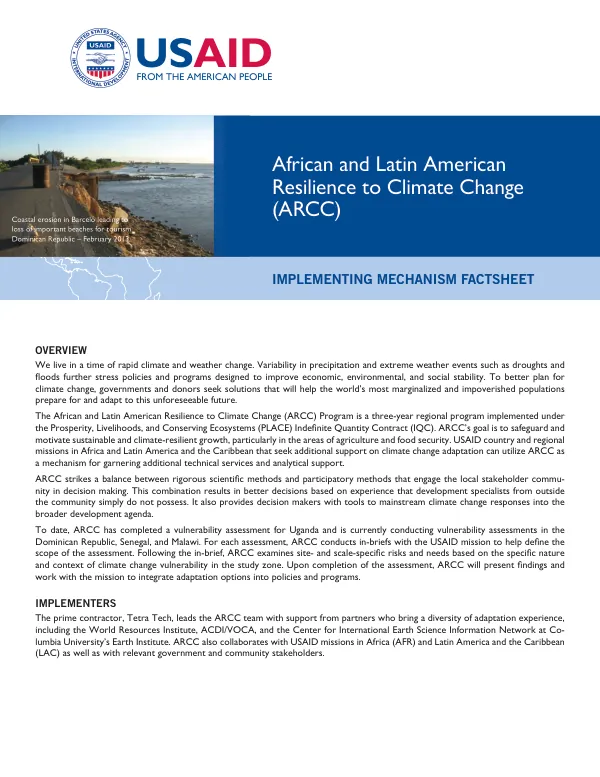
The African and Latin American Resilience to Climate Change (ARCC) Program is a three-year regional program implemented under the Prosperity, Livelihoods, and Conserving Ecosystems (PLACE) Indefinite Quantity Contract (IQC).
2013 · 2 pages
Sign in to readA free account is required to download.
Abstract
The program's goal is to safeguard and motivate sustainable and climate-resilient growth, particularly in the areas of agriculture and food security. ARCC is designed to be flexible to effectively address unforeseen support needs in both the Africa and Latin America and Caribbean Bureaus. ARCC strikes a balance between rigorous scientific methods and participatory methods that engage the local stakeholder community in decision making. This combination results in better decisions based on experience that development specialists from outside the community simply do not possess. It also provides decision makers with tools to mainstream climate change responses into the broader development agenda. To date, ARCC has completed a vulnerability assessment for Uganda and is currently conducting vulnerability assessments in the Dominican Republic, Senegal, and Malawi. The prime contractor, Tetra Tech, leads the ARCC team with support from partners who bring a diversity of adaptation experience, including the World Resources Institute, ACDI/VOCA, and the Center for International Earth Science Information Network at Columbia University's Earth Institute. ARCC also collaborates with USAID missions in Africa (AFR) and Latin America and the Caribbean (LAC) as well as with relevant government and community stakeholders. Key activities include the provision of assessment methodologies that will assist USAID adaptation-related programming, and vulnerability assessment tools to guide Feed the Future planning for USAID programs. ARCC provides knowledge management support on topics ranging from the evaluation of publicly available vulnerability indicators to research to improve downscaled climate change models that will facilitate decision making around adaptation, as well as technical assistance for field missions in Africa and the Latin American and Caribbean regions. ARCC also uses small grants to support innovation and capacity building of local research institutions and organizations. The program's four task areas are: Development of Vulnerability Assessments Methodologies; Outreach, Training, and Support; Knowledge Development and Management; and Technical Support to USAID Missions and Operating Units. The ARCC award budgets for time and materials (T&M) according to different categories of expertise. These price schedules are available from ARCC. The program is managed by USAID Activity Managers Tegan Blaine and Christine Pendzich, who act as gatekeepers for the work plan. Operating units interested in accessing ARCC services should contact the relevant Activity Manager to reach an agreed-upon scope of work, staffing plan, schedule, and budget. The program's award details include an AID-OAA-TO-11-00064 award number, issued under the Prosperity, Livelihoods, and Conserving Ecosystems: an Indefinite Quantity Contract, USAID Contract Number AID-EPP-I-00-06-00008, with a period of performance from October 2011 to September 2014 and a ceiling of $13 million.
Related documents