USAID DEC
African child survival initiative -- combatting childhood communicable diseases in Lesotho
Sign inUSAID. BUR. FOR AFRICA. OFC. OF TECHNICAL RESOURCES
African child survival initiative -- combatting childhood communicable diseases in Lesotho
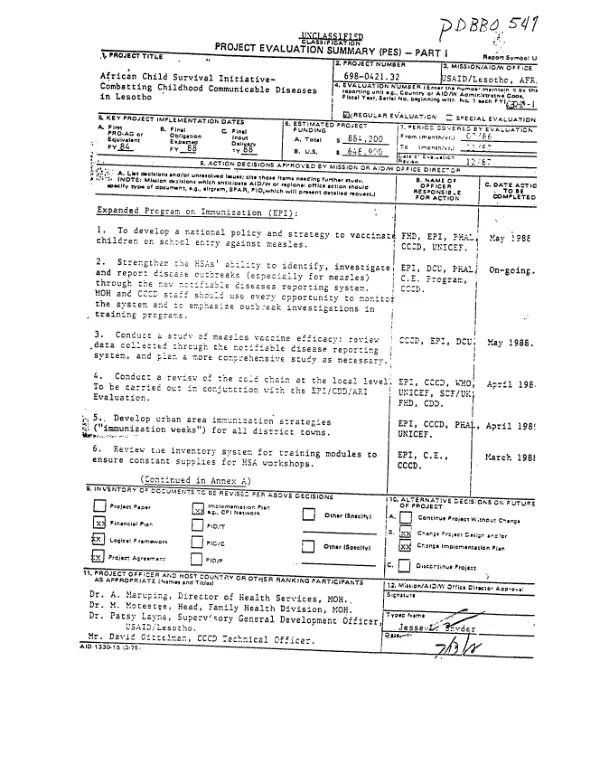
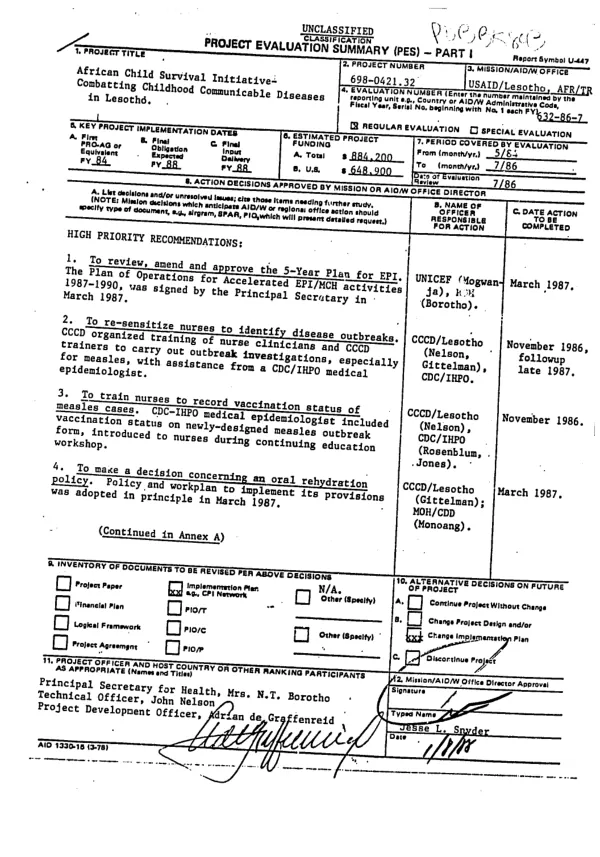
Summarizes unattached evaluation of the Lesotho subproject (SP) of the Combatting Childhood Communicable Diseases (CCCD) Project in Africa.
Borotho, N. T.; Nelson, John +1 more · 1988
Sign in to readA free account is required to download.
Abstract
Second-year external evaluation covered the period 5/84-7/86 and was based on field visits and interviews with personnel of the Ministry of Health (MOH), the Private Health Association of Lesotho, CCCD/L, USAID/L, and other donors. The SP is basically well run and is making good progress. Efforts to decentralize management and training have proceeded well, and the Expanded Program of Immunization"s (EPI) strong management has led to 65% coverage. An oral rehydration therapy (ORT) unit at Queen Elizabeth II Hospital, created to improve hospital diarrhea case management, reduced hospital mortality rates for diarrhea from 12% to 3%. Units scheduled to open in other hospitals should assure a drop in national mortality levels to the targeted 6% by 1989. In addition, the SP has supported the design and production of impressive health education materials which complement the intensive training activities. Several areas need improvement, however. Additional support is needed to improve management skills at all levels. Nurses need to focus on identifying and responding to outbreaks, especially of measles (measles morbidity increased from 5,821 cases in 1984 to 7,362 in 1985, despite high levels of vaccination coverage). The health information system faces serious reporting delays due to inadequate staff. The evaluation team saw little possibility of an increase in government financing to sustain SP activities, but suggested several methods to increase revenues and were optimistic about potential results. The SP"s decentralization of activities to the health service areas is a model for other countries; it has resulted in stronger local planning and more manageable training programs for health workers and community leaders. A total of 32 action decisions are included.
Related documents
Documents in this collection
![[Development Fund for Africa --] impact of child survival activities in Africa : a report on AID's progress in reducing infant and child mortality and illness in 17 child survival priority countries](https://covers.devme.ai/gen/8905.webp) 1989
1989USAID DEC
[Development Fund for Africa --] impact of child survival activities in Africa : a report on AID's progress in reducing infant and child mortality and illness in 17 child survival priority countries
Open record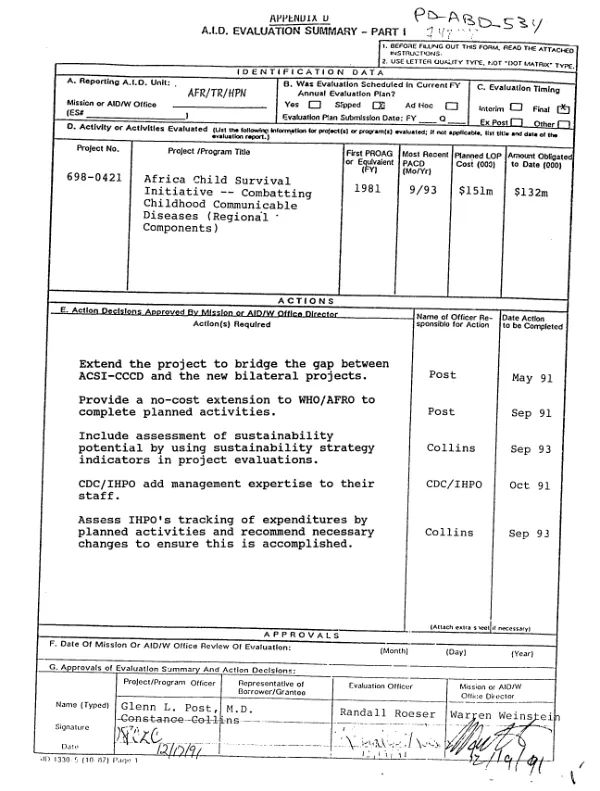 1991
1991USAID DEC
![[Development Fund for Africa --] impact of child survival activities in Africa : a report on AID"s progress in reducing infant and child mortality and illness in 17 child survival priority countries](https://covers.devme.ai/gen/72136.webp)