USAID DEC
African child survival initiative - combatting childhood communicable diseases in Lesotho
Sign inUSAID. MISSION TO LESOTHO
African child survival initiative - combatting childhood communicable diseases in Lesotho
Summarizes an internal evaluation of a project to help the Lesotho Ministry of Health (MOH) expand and upgrade child immunization and diarrheal disease control services and strengthen health education, training, and information systems.
1988
Sign in to readA free account is required to download.
Abstract
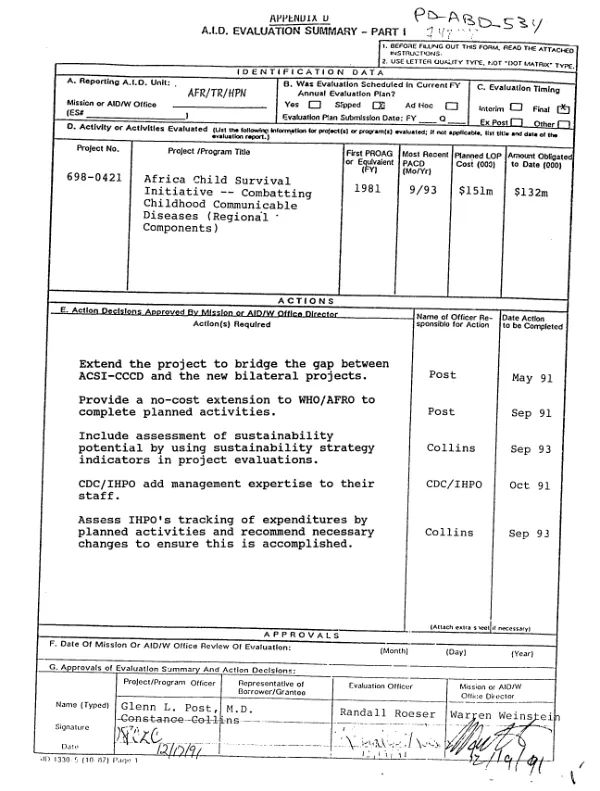
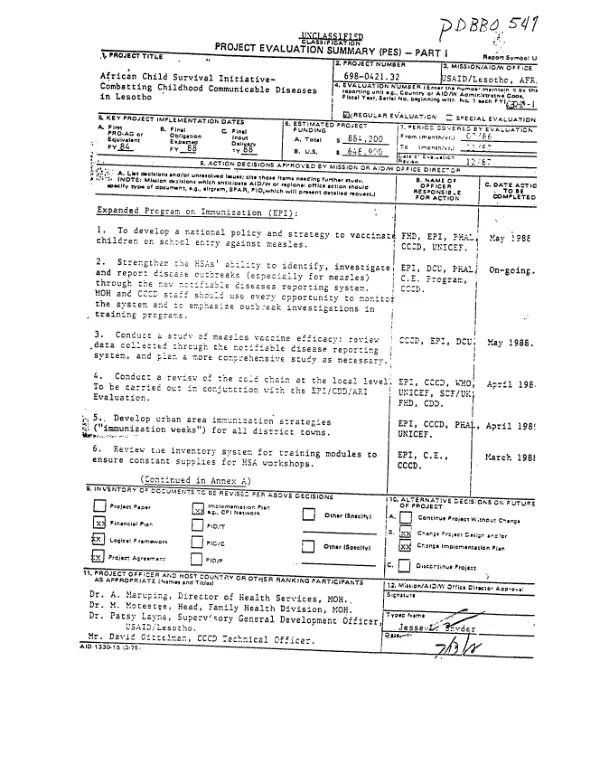
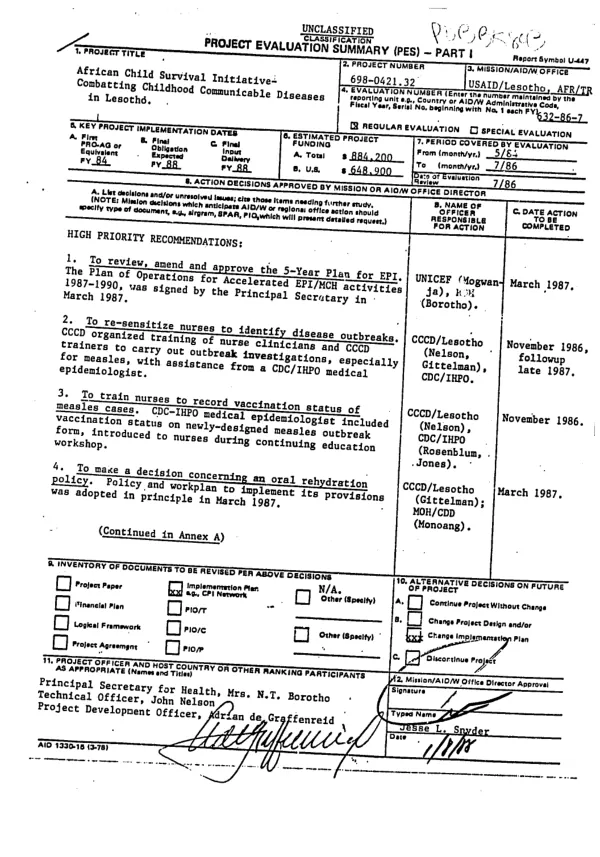
The evaluation covers the period 7/86-11/87. The project has successfully assisted with the training, health education, supervision, and logistics activities of the MOH immunization program. Intensified disease surveillance activities and urban "immunization weeks" in Maseru have also been supported. Some problems were experienced in procuring needles, syringes, cold boxes, and training manuals, but steps have been taken to resolve these problems, especially in improving USAID/L ordering procedures. The project has also worked successfully with the MOH to develop a national policy and implementation workplan for oral rehydration therapy (ORT). ORT activities have commenced in 16 of the country"s 18 hospitals, and 3 national ORT symposia for 110 health professionals were held in 9/87. Plans have been made to open ORT corners in health centers, but lack of transportation and funds for supervision, inadequate staffing, and varying commitment at the district level have slowed progress. The decentralized training program has had a positive impact on immunization coverage and ORT knowledge, although a comprehensive evaluation of the program should be conducted. With respect to health education, qualitative research and a baseline study of ORT and immunization knowledge and practices were conducted and standard ORT messages were adopted and disseminated through 10 radio programs. However, progress on planned print and graphics materials has been slowed by a lack of permanent staff. In response to the recommendations of an external review in 1986, the project has collected age-specific data on outpatients and organized a reporting system that greatly facilitates disease tracking, especially of measles. Nevertheless, the lack of adequate staff has prevented processing of inpatient and outpatient data, thereby impeding development of a timely and responsive health information system. A total of 45 action decisions are made, reflecting the Mission"s approval of the evaluation and its recommendations. Specific decisions are to extend the immunization/diarrheal diseases control component 5 years (through 5/93) and the health communications component 2 years (through 11/90). It is recommended that MOH staff shortages be considered in designing the programs. The internal evaluation is included as pp.6-12 of this document; recommenations from the 1986 evaluation are annexed, along with the project workplan for 1/87-3/88.
Related documents
Documents in this collection
 1988
1988USAID DEC
African child survival initiative -- combatting childhood communicable diseases in Lesotho
Open record![[Development Fund for Africa --] impact of child survival activities in Africa : a report on AID's progress in reducing infant and child mortality and illness in 17 child survival priority countries](https://covers.devme.ai/gen/8905.webp) 1989
1989USAID DEC