GLOBAL FUND
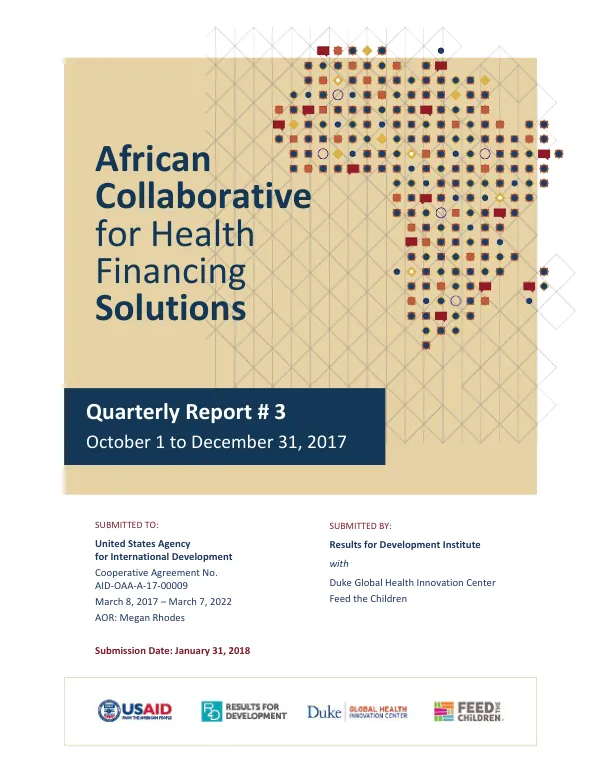
African Collaborative for Health Financing Solutions Quarterly Report #3
The African Collaborative for Health Financing Solutions (ACS) is a five-year project implemented by Results for Development (R4D) in partnership with Duke University and Feed the Children.
2018 · 16 pages
Sign in to readA free account is required to download.
Abstract
The project's goal is to advance Universal Health Coverage (UHC) in Sub-Saharan Africa by increasing regional and country implementation of UHC policies and programs. ACS will support this goal by working with regional bodies and country-level multi-stakeholder platforms to share knowledge, strengthen accountability, and promote health financing policies and processes that advance UHC. Four distinct objectives support the ACS program's purpose: Assessment of regional and country needs to advance UHC, considering both the public and private sector; Support to multi-stakeholder platforms for Accountability and Application of Knowledge (PAKs) in a subset of SSA countries; Facilitation of knowledge exchange between country PAKs and implementation support for health financing technical solutions and processes that advance UHC; and Support to regional bodies, networks, and NGO coalitions to share knowledge and strengthen accountability for UHC. During the third quarter of the project, October 1 to December 31, 2017, activities continued to focus on objective 1 of the ACS work plan and activities related to the consultation phase. The team conducted consultation visits in five countries, including Burkina Faso, Uganda, Senegal, Nigeria, and Tanzania. These visits were led by Cheickna Toure and Oko Igado, and followed a uniform consultation approach utilizing a preliminary set of consultation tools developed by the ACS team. The team also conducted global and regional consultation interviews, which provided a range of deep perspectives and opportunities to connect with a diverse range of stakeholders. The ACS team met in Dakar, Senegal on November 1 and 2 to debrief on the first wave of consultation visits. This two-day exchange included all members of the consultation teams, as well as one external partner, Claude Meyer from P4H, to provide an external lens and input into progress to date. The meeting created a unique and timely opportunity for the team to reflect, coalesce, and adjust the approach to the consultation visits, as well as to the project overall. Major changes that emerged from the meeting included revising consultation tools to ensure greater simplicity and harmonization, and adding focus group discussions to capture input from the community level for upcoming countries. A second wave of consultation visits occurred in November and December to Senegal, Nigeria, and Tanzania. These visits were completed in mid-December and marked the end of country consultations. All results from interviews at the global, regional, and country levels will be consolidated in the final synthesis report. The team also continued working with their design firm and building from their project one-pager, ACS created a set of communications materials that could be used during the consultation phase. The ACS team remains engaged with the Benin mission and will include Benin participation at the regional workshop. Following the Uganda consultation visit, the Uganda Mission expressed interest in pursuing ACS support to assist with the development of a country-specific roadmap for UHC. The ACS team remains in discussion with the mission about a scope of work and is looking hopefully forward to implementation. Outputs from the third quarter include final project visuals, country briefs, stakeholder analysis briefs, advocacy strategy and communications plans, completed consultation tools, consultation reports, regional team work plans, and report from two consultation visits. The team also conducted consultations with various organizations, including Thinkwell, European Agency for Development and Health (AEDES), Bill and Melinda Gates Foundation, Global Fund, World Health Organization, Japan International Cooperation Agency, and P4H.