MEDICAL SERVICE CORP. INTERNATIONAL
African trypanosomiasis
African sleeping sickness (trypanosomiasis) is endemic in 36 countries where the vector, the tsetse fly (Glossina), is found.
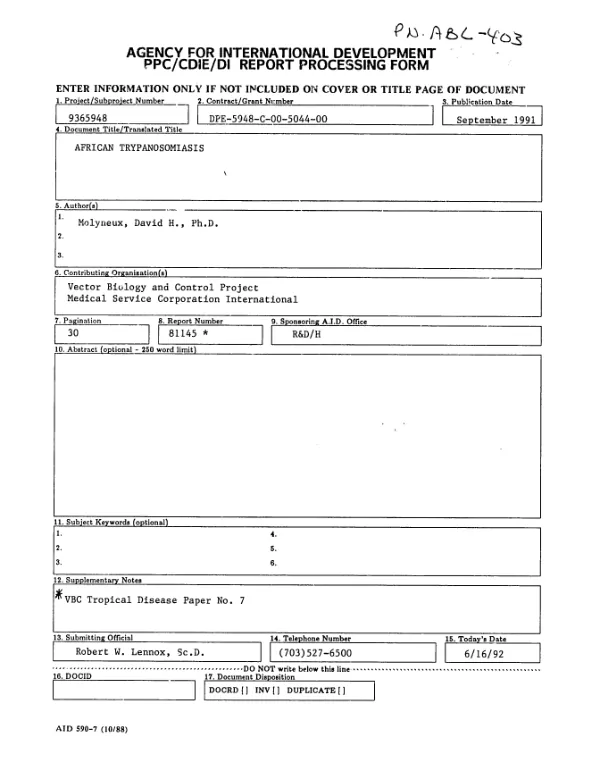
Molyneux, David H. · 1991
Sign in to readA free account is required to download.
Abstract
Recent estimates suggest that some 50 million people are at risk of acquiring the disease and at least 25,000 new cases occur every year. Two forms of the disease are recognized. An acute infection caused by the more virulent Trypanosoma brucei rhodesiense, rhodesian sleeping sickness is found in east and south-central Africa. The chronic T.b. gambiense, or gambian sleeping sickness, is found in west and central Africa. A third form, T.b. brucei, causes "nagana," an immensely important disease of livestock. Major epidemics with high mortality have occurred several times in this century. Half a million deaths were reported in Zaire from 1896 to 1906. Another epidemic along Lake Victoria killed approximately 250,000 people. Outbreaks of both forms of sleeping sickness continue to occur in areas of Uganda, Rwanda, Kenya, Zaire, and Sudan. Gambian sleeping sickness is largely dependent on transmission between humans and tsetse flies, but a peri-domestic cycle including pigs, dogs, and cattle is also possible. Antelopes and other game serve as reservoirs of rhodesian sleeping sickness in the wild, and cattle are domestic reservoirs. Both forms of the disease are almost invariably fatal if untreated. Symptoms in the disease"s early stages include intermittent fevers, headaches, swollen glands, intense itching, and general malaise. When the central nervous system is invaded, the predominant symptoms reflect pathological changes in the brain, often leading to drowsiness, somnolence, and eventually a comatose state. Early-stage sleeping sickness is easier and less hazardous to treat than late-stage disease. Suramin is used for treating T.b. rhodesiense. Suramin or pentamidine can be used for treatment of early stages of T.b. gambiense. Late-stage sleeping sickness has been treated with melarsoprol, but the drug"s side effects can lead to death and many cases are refractory to treatment. Over 90% of more than 600 patients with late-stage gambian sleeping sickness who had not responded to treatment with melarsoprol have been cured with a new drug, eflornithine. Both melarsoprol and eflornithine are expensive (about $140 per patient) and require several weeks of hospitalization for the patient. Unlike melarsoprol, eflornithine is not effective against T.b. rhodesiense. Human trypanosomiasis is focal because tsetse fly distribution is restricted to specific vegetational habitats, including riverine forests, savannah, and scrub. Early control measures based on destruction of game and tsetse habitats were effective, but have been largely abandoned for conservation purposes. Recently, traps have proved an effective tool for tsetse control. Scent-baited traps impregnated with pyrethroid insecticides are very efficient in reducing local populations of vectors in both West and East Africa. A pyramid-shaped trap that does not require insecticides has also shown great promise. Traps are inexpensive and, with appropriate training, can be maintained by community members. (Author abstract)
Related documents