USAID DEC
Bolivia : current status and potential development of control strategies for Chagas" Disease, Feb-March 1990
Sign inMEDICAL SERVICE CORP. INTERNATIONAL
Bolivia : current status and potential development of control strategies for Chagas" Disease, Feb-March 1990
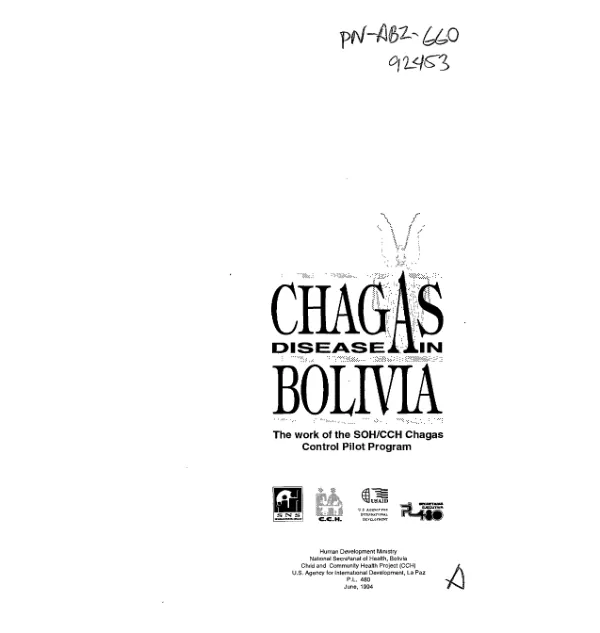
Chagas" disease (a form of trypanosomiasis native to tropical areas of the Americas) is more prevalent in Bolivia than anyhere else and may be the country"s most serious health problem.
Bryan, Ralph T.; Tonn, Robert J. · 1990
Sign in to readA free account is required to download.
Abstract
This study, based on a survey of five "chagistic" areas, assesses the extent of Chagas" disease in Bolivia, reviews existing control efforts (including those of PVO"s), and identifies areas in which A.I.D. and other donors could strengthen the control of Chagas" and other vector-borne diseases. About 40% of the Bolivian population is seropositive, with 70%-100% seropositivity in some areas. Congenital transmission ranges from 8%-36%, while seropositivity rates in blood donors are 45%-70% or about three times that of Argentina, Brazil, Chile, or Venezuela. The rates of child mortality due to Chagas" range from 2.6% to 46%, with a national mortality level of 32% for congenital cases. In spite of these high figures and the fact that the disease is largely preventable, Bolivia does not have a national Chagas" disease control program. Efforts should focus on improvements to adobe homes and homes with thatched roofs (which are ideal habitats for the triatomine vectors of Chagas" disease), insecticide treatment of homes and adjacent buildings, health education, and research, especially into the roles of blood transfusions and congenital transmission. fetal, infant, and child mortality and morbidity, Chagas" disease should receive greater priority in child survival efforts.
Related documents