USAID DEC
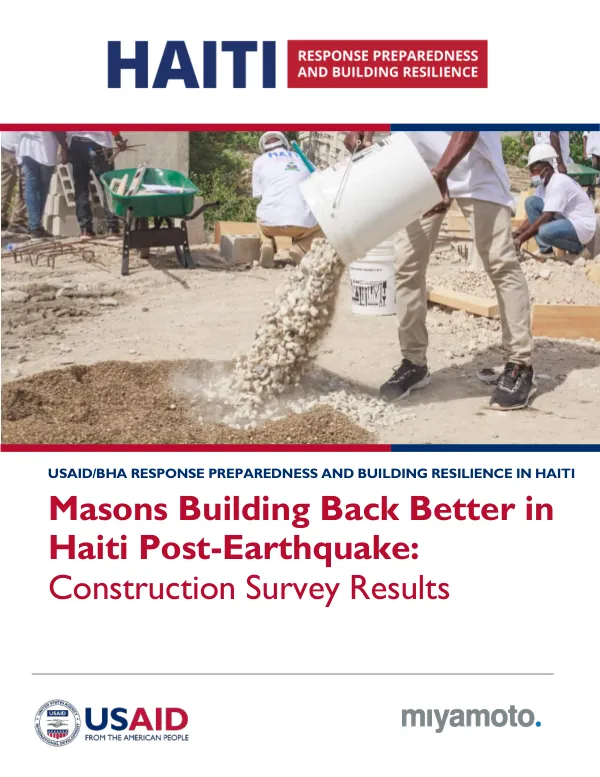
USAID/BHA Response Preparedness and Building Resilience in Haiti: Masons Building Back Better in Haiti Post-Earthquake: Construction Survey Results
Sign inMIYAMOTO INTERNATIONAL, INC.
USAID/BHA Response Preparedness and Building Resilience in Haiti: Masons Building Back Better in Haiti Post-Earthquake: Construction Survey Results
The USAID/BHA Response Preparedness and Building Resilience in Haiti project aimed to facilitate the expansion of the sustainable earthquake and hurricane damage assessment system in Haiti and build technical and institutional resilience for a reduction in internally displaced people, lives lost, people injured, and social and economic disruption.
2021 · 37 pages
Sign in to readA free account is required to download.
Abstract
The project was implemented under the USAID/BHA Response Preparedness and Building Resilience in Haiti program, with Miyamoto International, Inc. as the lead implementing partner. The project's goal was to quantify the current quality of construction practice of masons in the Port-au-Prince region through a sampling of typical construction techniques and material quality. A total of 87 masons (45 teams) from four areas in Port-au-Prince, including informal developments, were randomly selected to take part in the study. To evaluate current construction practices, a sample masonry wall and reinforced concrete column were constructed by each mason team. The evaluation results for construction of the critical elements, i.e., masonry wall, concrete column, and material selection, show significant improvement compared to pre-earthquake construction practices. 97% of teams selected correct materials based on the Ministry of Public Works, Transport and Communications (MTPTC) guides for construction. Materials included cement, aggregates, masonry blocks, vertical reinforcing for masonry wall and concrete column. In addition, 80% of the teams constructed the reinforced concrete column per the MTPTC guidelines and 87% of the teams had constructed elements of the masonry wall per the MTPTC guidelines. The two areas with poor results were masonry joint construction and concrete mixing, with 29% and 24% compliance, respectively. Our analysis for one- and two-story buildings shows the estimated probability of collapse for the non-compliant state (prior to 2010) was over 50% due to intense ground motion, Maximum Considered Earthquake (MCE). Based on current improved practice, the probability of collapse is reduced to less than 25% for new construction. Selection of quality materials improves the resilience of post-earthquake construction in the region. In addition, improved construction practices, including vertical reinforcing in the wall and column and seismic detailing, result in more robust and resilient structures compared to those built prior to the earthquake in 2010. Therefore, as both have been observed during the mason survey, overall construction quality resulting from material selection and construction practices have improved significantly following the earthquake in 2010. Another significant finding was that only 37% of masons evaluated had technical construction training and only 21% participated in earthquake reconstruction. Only 30% of the masons evaluated were aware of the existence of MTPTC guidelines. This illustrates that professional standards and practices among masons, including those coming from informal developments, have significantly improved. The 'Build-Back-Better' concept linked reconstruction with capacity building, for generational impact. The study's methodology involved a construction practice exercise, where mason teams were asked to construct a sample masonry wall and reinforced concrete column. The construction material selection, masonry wall and concrete column sample, and construction evaluations were also assessed. The study's limitations were acknowledged, and the results were analyzed to provide insights into the current state of construction practices in the Port-au-Prince region. The findings of the study have significant implications for the construction industry in Haiti. The improved construction practices and material selection have resulted in more robust and resilient structures, which can withstand earthquakes and other natural disasters. The study's results also highlight the need for continued capacity building and training for masons, particularly those from informal developments. By promoting professional standards and practices, the construction industry in Haiti can contribute to the country's long-term development and resilience.
Related documents