DFID
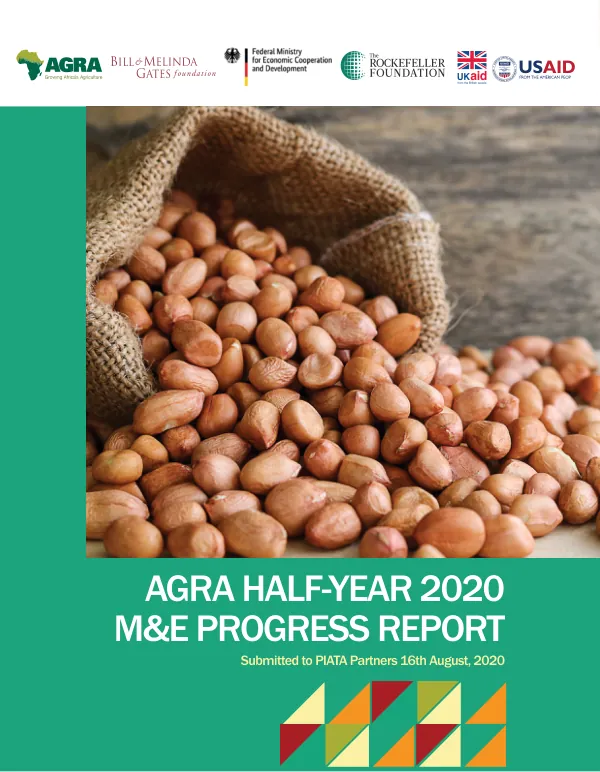
AGRA HALF-YEAR 2020 M&E PROGRESS REPORT
AGRA's agricultural development initiative in Africa began with a focus on catalyzing a sustainable and inclusive agricultural transformation.
2020 · 36 pages
Sign in to readA free account is required to download.
Abstract
The organization's strategy aims to increase incomes and improve food security for 9 million smallholder households directly through downstream systems development and a further 21 million smallholder farmers indirectly through upstream work. AGRA is supporting 11 countries to attain and sustain an agricultural transformation, delivering through a shared Results Framework with the PIATA partners. AGRA's work has been anchored in facilitating an agricultural transformation agenda that drives impact at scale through targeted investments in three main bodies of work: Policy and State Capability (PSC), Partnerships, and Systems Development. The PSC work focuses on working with government to strengthen execution capacity while enhancing the transparency, accountability systems, and policy environment for increased public and private sector investment in agriculture. Partnerships work focuses on facilitating the alignment between government priorities and private sector interests, improving integration and coordination, which leads to securing investments critical to the agriculture sector to benefit smallholder farmers. Systems Development focus is on building downstream delivery systems closer to smallholder farmers while providing support to local private sector to scale technologies and services that deliver better productivity and incomes. AGRA's interventions have contributed to a general upward trend in agriculture growth over the last 10 years, with some trends like intra-Africa trade in exports growing at exponential rates. Poverty headcount ratio across Africa reduced by 7.22% between 2006 and 2018, with a higher reduction of 10.6% in the AGRA focus countries. The global hunger index across Africa reduced by 6.82 and 6.26 for 2006-2018 and 1995-2005 periods respectively, with a higher hunger index average reduction of 8.41 in AGRA key focus regions. Crop yields have shown sharp fluctuations from year to year, but maize yield between 2006 and 2017 increased from 1.77 MT/ha to 2.08 MT/ha compared to 1.39 MT/ha and 1.7 MT/ha between 1995 and 2005 across Africa. The average increase in the AGRA focus regions increased by an average of 0.6 MT/ha. Cassava yields across Africa reduced on average from 9.22 MT/ha in 2005 to 8.82 MT/ha in 2017, with a higher decrease in the AGRA focus regions of 1.13 on average. AGRA's work through the DFID-funded Food Trade and Resilience Program is expected to significantly boost the increasing trend in intra-Africa agricultural trade in exports. Fertilizer use is generally on a slow upward trend in the recent 10 years, but just a little over half of the CAADP target of 50 kg/ha. AGRA's recent outcomes monitoring surveys showed only Nigeria among the seven AGRA-focus countries had attained the CAADP target at 51 kgs/ha. AGRA's interventions are starting to yield results towards a desired impact, with key changes including the strengthening of government capacity in service delivery to farmers, the successful support of the design of bankable flagships to help governments prioritize and articulate Agriculture investment opportunities, and the reduction of average time in evidence-based micro-policy reform processes. These changes are expected to be contributing to some of the impact level changes observed in the focus countries.