ECO CONSULTING GROUP
REEP-A YEAR 5 ANNUAL WORKPLAN
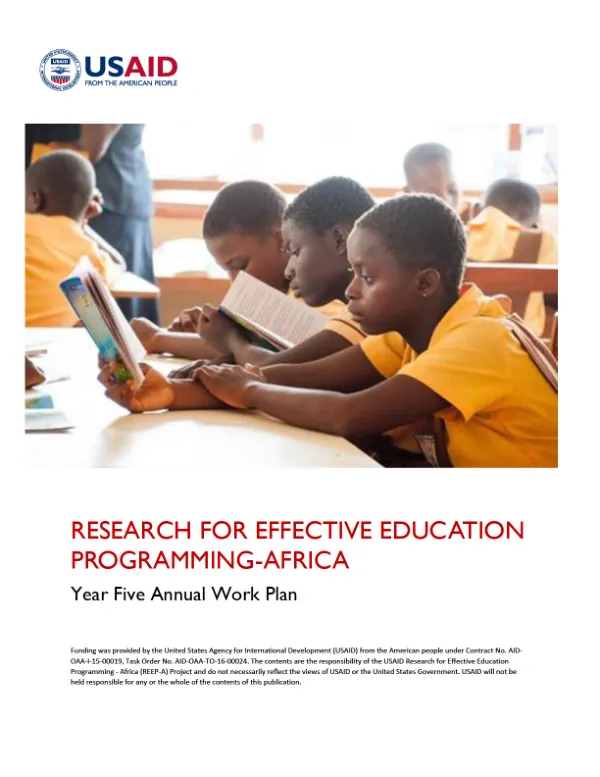
The Research for Effective Education Programming – Africa (REEP-A) project aims to provide the United States Agency for International Development (USAID) Africa Bureau and Mission offices with concrete contributions to research on USAID education initiatives.
2020 · 24 pages
Sign in to readA free account is required to download.
Abstract
The project's overarching aim is to inform evidence-based investment, decision-making, and the prioritization of needs. REEP-A will contribute to USAID's education aims in Africa by providing technical and advisory services focused on research and capacity building, to enhance the quality and effectiveness of USAID activities. REEP-A will provide practical and action-oriented gender-sensitive research that will be applied to both project design and implementation. The project aims to strengthen the relationships and links between project evaluation, design, and implementation. In addition, REEP-A will contribute to the capacity development of education personnel and partners by enhancing the use of research in decision-making, mainstreaming the application of feedback-loops and lessons learned into project design and implementation, and expanding the evidence and knowledge base on education initiatives. The USAID Education Strategy, issued in 2011, has promoted the rigorous use of evidence-based programming across the Strategy's three education goals. The education goals set targets for 2015, focusing on early grade reading, workforce development, and education in crisis and conflict-affected environments. REEP-A aims to expand on the progress and evidence base established by the Data for Education Research and Programming in Africa project (DERP) and seeks to target identified gaps and challenges. To meet the ambitious aims for both USAID's Education Strategy Goals 1 and 3, it is critical that resources are used effectively and strategically to ensure the greatest gains. REEP-A aims to provide theories of change that will inform investment decisions, using a gender-sensitive lens. Through rigorous research, including the monitoring and evaluation of projects, REEP-A strives to address research gaps and expand the knowledge base on effective education programming. REEP-A targets topics and issues that have not received sufficient analysis, and addresses new challenges that have emerged in the last five years. These include additional support to Africa Missions, increased emphasis on cost-effective approaches that promote sustainability, enhanced understanding of the efficacy of early grade reading interventions, targeted focus on girls and the role of gender-based dynamics in promoting or inhibiting progress, and enhanced understanding of programmatic issues in enrolling and retaining children and youth living in crisis and conflict areas. REEP-A extends the analytic framework of DERP, building on the progress made in expanding the evidence base and improving data collection, and further explores areas for research that were identified as critical during the research program. REEP-A is designed to be flexible and to adapt over time to respond to emerging areas of inquiry and to adequately address practical areas of concern, including bottlenecks and challenges in achieving desired program outcomes. The portfolio of education initiatives being implemented by Africa Missions is heavily concentrated on Early Grade Reading (Goal 1) projects, with the number of Goal 1 projects significantly higher than the combined total of both Goal 2 and Goal 3 projects. Currently, 19 Africa Missions have Goal 1 projects, which together reach the largest number of beneficiaries of Goal 1 initiatives globally. Mirroring this emphasis on Early Grade Reading, REEP-A has a heavier focus on research related to Goal 1. Following the launch of the Strategy in 2011 and through 2015, the reading skills of around 30 million children globally were improved, of which 24 million are in Sub-Saharan Africa. However, despite these gains, progress toward enhanced early grade reading and access to quality education in conflict and crisis settings in Africa have been modest. Expanding the evidence base and data collection for education interventions in Africa is critical to spurring further progress, increasing the understanding of program effectiveness, identifying barriers, and replicating successes.