USAID DEC
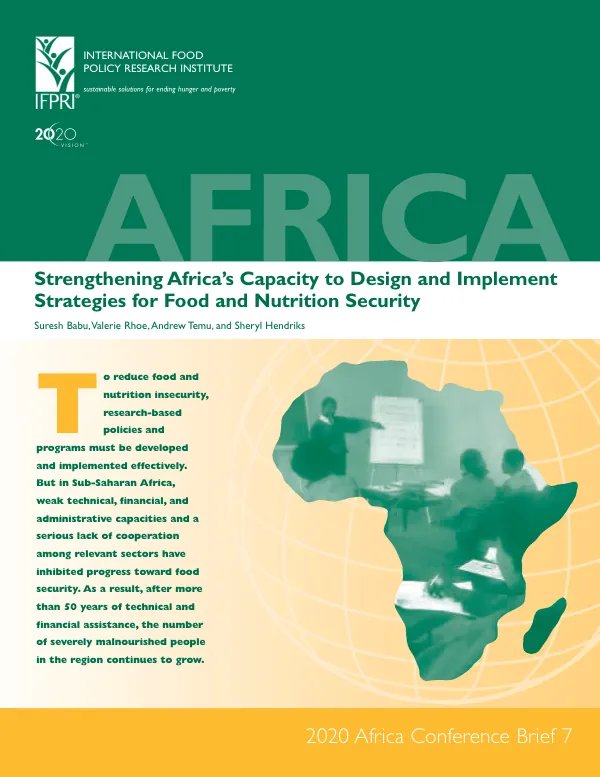
Strengthening Africa’s Capacity to Design and Implement: Strategies for Food and Nutrition Security
Sign inINTERNATIONAL FOOD AND POLICY RESEARCH INSTITUTE
Strengthening Africa’s Capacity to Design and Implement: Strategies for Food and Nutrition Security
Strengthening Africa's Capacity to Design and Implement Strategies for Food and Nutrition Security is a critical challenge in the region.
2020 · 6 pages
Sign in to readA free account is required to download.
Abstract
To reduce food and nutrition insecurity, research-based policies and programs must be developed and implemented effectively. However, in Sub-Saharan Africa, weak technical, financial, and administrative capacities, as well as a lack of cooperation among relevant sectors, have hindered progress toward food security. Capacity-strengthening challenges in the region include inadequate in-country capacity, institutional weaknesses, and a lack of multidisciplinary approaches to problem-solving. External technical assistance aimed at strengthening human and institutional resources has had limited impact due to weaknesses in identifying, designing, and implementing projects, inadequate skills to address food and nutrition security policy issues, inadequate management of technical assistance, and poor local working environments. The capacity to design and implement successful food security policies and programs in Africa is weak from the global to the community level. Even when adequate capacity exists within a country, expatriates are often hired because donors require parallel operational structures to be implemented with their project units, or expatriates fill positions that the government cannot afford to fund. However, expatriates often lack the in-country experience needed to understand local problems and find appropriate solutions. Public institutions often lack the necessary good governance to function properly at all, let alone to implement long-term food security policies and programs. The Millennium Development Goals set by the international development community challenge global, national, subnational, and community-level institutions to reduce hunger by half by 2015. Sub-Saharan Africa's meager human and institutional capacity for action is impeding the realization of this goal. Capacity strengthening is the process by which individuals, groups, organizations, and communities enhance their ability to identify and meet food and nutrition security challenges in a sustainable manner. Central to the process are human capabilities, effective organizations, and sound institutional principles. Capacity strengthening should be viewed as a special dimension of the overall development process, enabling societies to fulfill their needs in a sustainable manner. Africans must recognize that development partners can only offer resources and facilitate the process of ensuring food security; the implementation of policy and achievement of desired levels of food and nutrition security remain in the hands of Africans. Enhancing human resource capacity in African countries is therefore the foundation for achieving the overall goal of food and nutrition security in Africa. Designing policies and programs for food and nutrition security is an evolving multi-step process. Africa needs to strengthen its capacity to detect and diagnose indicators of distress, develop and execute relief programs during times of need, and observe current changes and link them to future crises. Collaborating with national counterparts would enhance the understanding of foreign technical assistants and create a sense of ownership among local people. Within a country, most food and nutrition security actions are planned at the national level, with government agencies, universities, and research institutions contributing to policy design and implementation capacity. To strengthen cooperation, frequent national meetings of all potential donors, universities, research institutions, and policymakers should be held, focusing on the planning of current, medium-, and long-term activities to foster food and nutrition security. University training in Africa tends to focus on general education, resulting in a significant skill gap in food and nutrition security policy. The Regional Food Security Training Programme (RFSTP) of the Southern African Development Community (SADC) has successfully bridged this gap by enhancing the ability of local academic institutions to undertake short-term training. However, short-term training is only a band-aid, and the next generation of policymakers, policy advisors, and policy researchers requires training on food and nutrition security at the university level.
Related documents