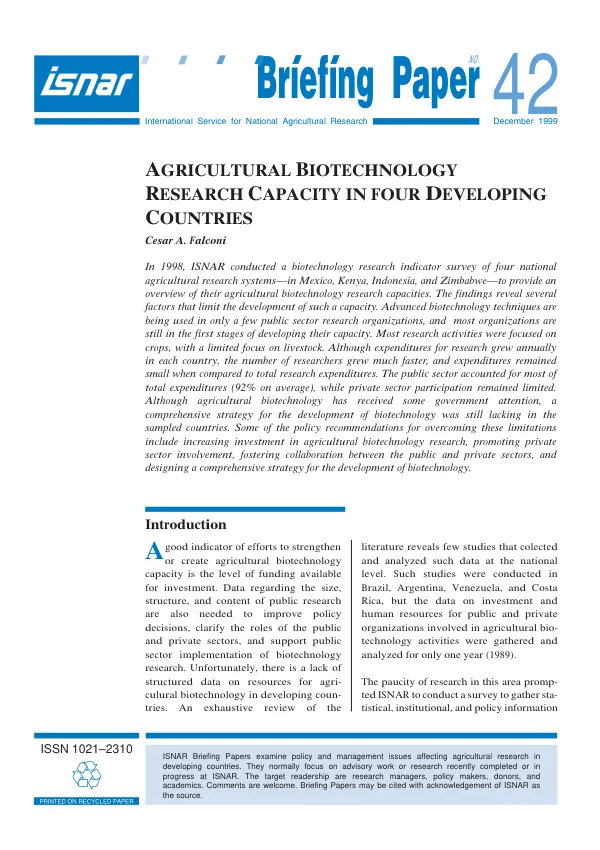
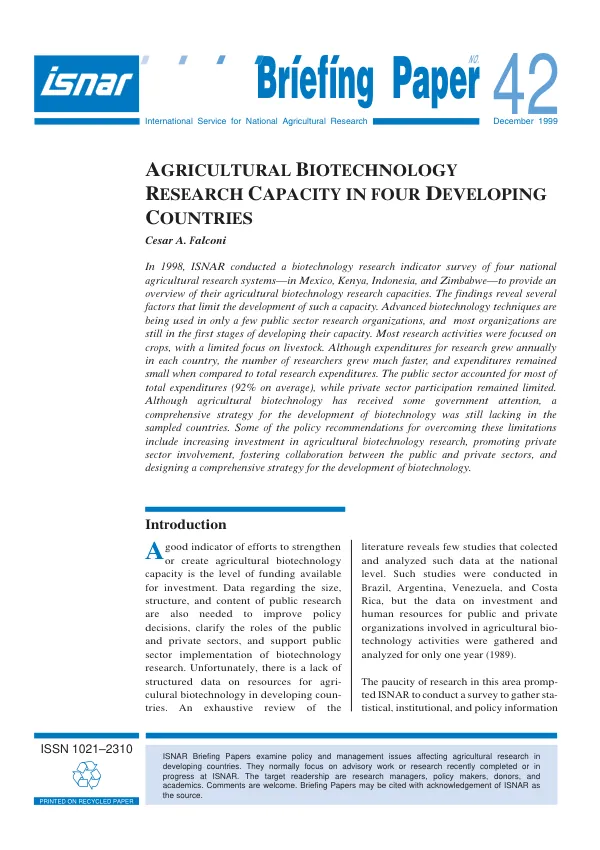
INTERNATIONAL SERVICE FOR NATIONAL AGRICULTURAL RESEARCH (ISNAR)
Agricultural biotechnology in developing countries : a cross-country review
Rapid developments in global agricultural biotechnology are prompting developing countries to set up programs in this field.
Komen, John; Persley, Gabrielle · 1993
Sign in to readA free account is required to download.

Abstract
Growing numbers of governments are investing in infrastructure and human resources, and adopting policies to facilitate biotechnology R&D in both the public and private sectors. This report describes the wide-ranging approaches to, and experiences with, biotechnology in China, Colombia, Egypt, India, Indonesia, Kenya, Malaysia, the Philippines, Thailand, and Zimbabwe; and provides a basis for program planning and implementation elsewhere. The report examines research institutions and programs established in the various countries, how governments have regulated biotechnology (e.g., biosafety and intellectual property rights), and how they address constraints to the development of agricultural biotechnology. Different countries have taken different approaches to stimulating biotechnology. The institutional framework that is possible or desirable for a country depends on the size of the country, the strength of its science and technology sector, and its existing research infrastructure. Conditions necessary for productive biotechnology programs include: close collaboration between new biotechnology and conventional agricultural research (especially plant breeding); minimal duplication of expensive equipment and services; effective working environment for well-trained scientists; adequate financial resources. Possible institutional arrangements include the following: (1) establishing a national biotechnology agency to coordinate and fund biotechnology within existing institutions and to determine national policies; (2) stimulating research at designated centers of excellence; and (3) creating a national biotechnology institute. The report discusses the advantages and disadvantages of the 3 approaches in the context of specific countries. Also discussed are approaches to biosafety and intellectual property rights. Most of the 10 countries are currently developing a suitable national framework for biosafety. These are based on existing national regulatory systems and internationally agreed-upon biosafety guidelines, such as those advocated by the Organization for Economic Cooperation and Development (OECD). The need to introduce legislation treating biotechnology inventions as intellectual property is under debate in many countries. The effect of such protection on innovation in biotechnology research is still not clear and warrants additional study. However, the trend in developing countries is to strengthen intellectual property protection, and is, in part, a result of bilateral negotiations and international trade negotiations. In most of the countries, lack of financial resources, restricting staffing, equipment, and operational budgets, is a major constraint to the growth of biotechnology. An additional constraint in most countries is the lack of clear problem definition and priority setting against which to formulate an R&D strategy. Increasingly, biotechnology research is financed by bilateral and multilateral donor agencies and development banks. However, this cannot substitute for fostering local investment. In the long run, biotechnology is likely to require greater private-sector involvement, particularly in marketing and distributing research products. Examples are cited of measures being taken in different countries to encourage the private sector to invest in these downstream activities. (Author abstract)