USAID
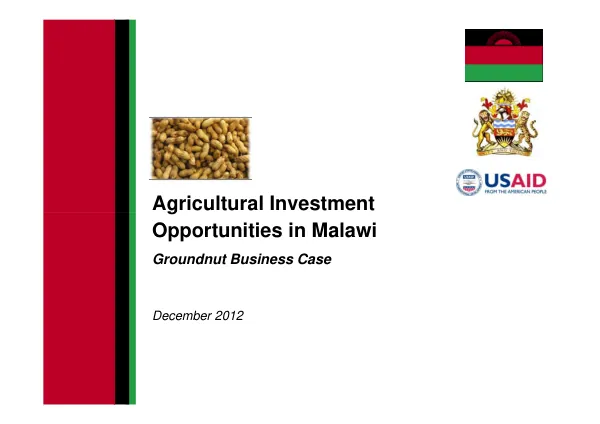
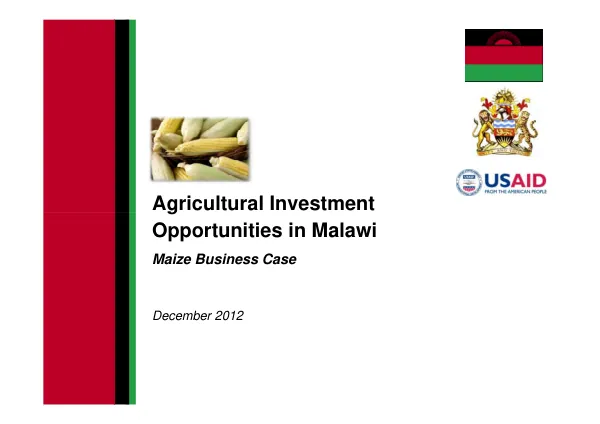
Agricultural Investment Opportunities in Malawi
Malawi boasts a widely diverse topography and scenery, ranging from sweeping lake views, breathtaking woodlands, and cityscapes.
2012 · 33 pages
Sign in to readA free account is required to download.
Abstract
The official language of Malawi is English, with Chichewa also widely spoken. The country has a population of 15.4 million people and a land area of 118,500 square kilometers, comparable in size to the U.S. state of Pennsylvania. The capital city is Lilongwe, and the second-largest city, Blantyre, is the center for commercial activity. Malawi's economy has experienced steady growth over the last several years, with agriculture being a significant contributor, representing 30% of GDP in 2011. The sector has grown at a compound annual growth rate of 8.3% from 2006 to 2011. Agriculture is expected to continue to be a major part of Malawi's economy, with the sector's contribution to GDP expected to remain high. Malawi has significant resources that support diverse crops, including good water supplies, vast land, favorable agro-ecological conditions, and capable farmers. The country has abundant water, with Lake Malawi and Lake Chilwa covering over 20% of its land area. There is significant potential for irrigation in the Shire River Valley for winter cropping. If irrigation is fully implemented, Malawi has enough water to become completely food independent. Malawi has five distinct agro-climatic zones: Highlands, Escarpment, Plateau, Upper Shire Valley, and Lower Shire Valley. These regions have different soil textures and rainfall patterns and support a mix of crops, including cereals, legumes, and cash crops. The majority of farmers possess at least basic skills in agriculture, and the country's smallholder farmers are inclined and responsive to markets, growing crops they can sell. The country's smallholder farmers require training in improved methods to improve agricultural output. Malawi's smallholder farmers are inclined and responsive to markets, growing crops they can sell. The country's inbred agrarian culture is a significant factor in its agricultural development. The Maize Investment Opportunity in Malawi is a local processor of high-quality Likuni Phala (Corn Soya Blend), which supplies to the Government of Malawi's National School Meals Program. The company plans to scale up the National School Meals Program, creating a future demand gap that needs to be filled. To expand production and increase levels of mechanization, the company is looking for a USD 300,000 investment. The investment opportunity has a secured and growing market, with limited local competition in the Corn Soya Blend processing landscape. The company is currently receiving donor and sector support to upgrade its plant and machinery to meet World Food Program and UNICEF requirements. The company wants to increase its capacity and level of mechanization to meet growing market demand and become a certified supplier to World Food Program and UNICEF. The Government of Malawi is encouraging sector-led growth through policy reforms and incentives to attract investment. The company's key challenges include market awareness, limited cash flow, and geographical reach, which have mitigation strategies in place. The investment will enable the company to increase its production capacity, improve its efficiency, and become a certified supplier to World Food Program and UNICEF.