DELOITTE CONSULTING, LLP
USAID Southern Africa Energy Program
The USAID Southern Africa Energy Program (SAEP) is a Power Africa initiative that aims to increase power generation and access to electricity throughout the region.
2019 · 2 pages
Sign in to readA free account is required to download.
Abstract
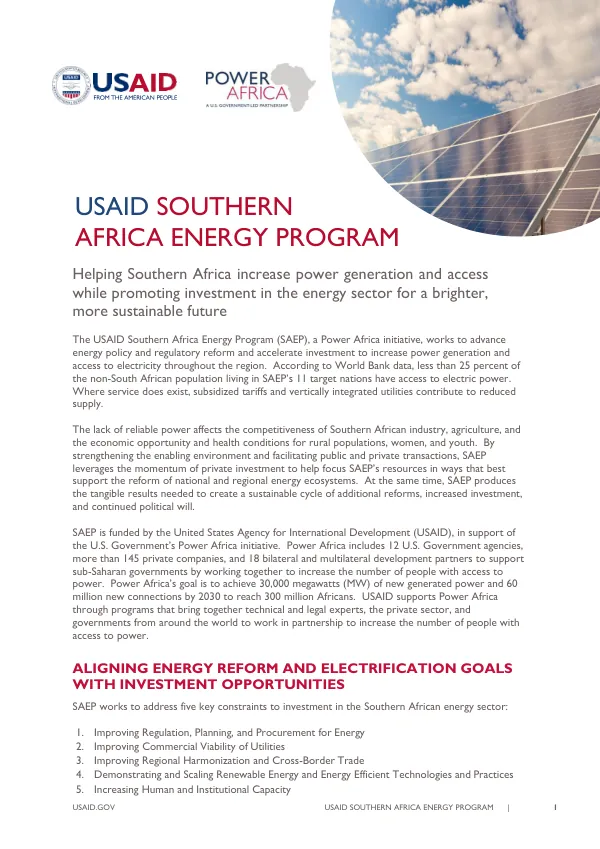
SAEP works to advance energy policy and regulatory reform, and accelerate investment to address the lack of reliable power in Southern Africa. According to World Bank data, less than 25 percent of the non-South African population living in SAEP's 11 target nations have access to electric power. Subsidized tariffs and vertically integrated utilities contribute to reduced supply, affecting the competitiveness of industry, agriculture, and economic opportunities for rural populations, women, and youth. SAEP leverages the momentum of private investment to strengthen the enabling environment and facilitate public and private transactions. The program focuses on reforming national and regional energy ecosystems, producing tangible results to create a sustainable cycle of additional reforms, increased investment, and continued political will. SAEP is funded by the United States Agency for International Development (USAID) in support of the U.S. Government's Power Africa initiative. Power Africa includes 12 U.S. Government agencies, more than 145 private companies, and 18 bilateral and multilateral development partners to support sub-Saharan governments in increasing access to power. SAEP addresses five key constraints to investment in the Southern African energy sector: improving regulation, planning, and procurement for energy; improving commercial viability of utilities; improving regional harmonization and cross-border trade; demonstrating and scaling renewable energy and energy-efficient technologies and practices; and increasing human and institutional capacity. The program works to improve the regulatory environment, commercial viability of utilities, regional harmonization, and the adoption of renewable energy and energy-efficient technologies. SAEP has facilitated the financial close of approximately 2,200 MW of new renewable energy generation capacity and added 9,390 MW to the Power Africa transaction pipeline. The program has guided multiple national regulators in analyzing utility tariff change applications, provided regulatory authorities with leading practice processes for tariff reviews, and developed a geospatial model in Zambia to map the entire country and identify areas without electricity. SAEP has also supported the growth of the solar home system market in Malawi by giving companies streamlined access to support, including operational assistance, working capital financing, and grants.
Related documents