GOVERNMENT OF MALAWI
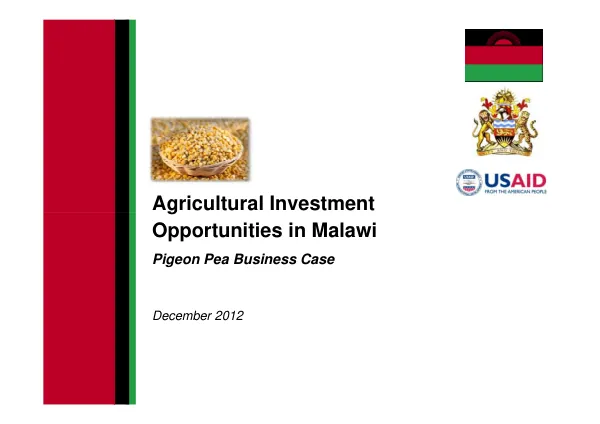
Agricultural Investment Opportunities in Malawi: Pigeon Pea Business Case
Malawi, a Southern African country, boasts a diverse topography and scenery, ranging from sweeping lake views to breathtaking woodlands and unique cityscapes.
2012 · 34 pages
Sign in to readA free account is required to download.
Abstract
The official language of Malawi is English, but Chichewa is also widely spoken. The country has a population of 15.4 million people and a land area of 118,500 square kilometers, comparable in size to the U.S. state of Pennsylvania. Malawi's economy has experienced consistent growth over the last several years, with agriculture being an important contributor, representing 30% of GDP in 2011. The sector is expected to continue to be a major part of Malawi's economy, having grown at approximately 8.3% per annum from 2006 to 2011. Malawi's economy has been growing steadily, at a compound annual growth rate of 12.8%. The country possesses significant resources that support diverse crops, such as good water supplies, vast land resources, favorable agro-ecological conditions, and capable farmers. Abundant water supply is available from Lake Malawi and Lake Chilwa, which cover over 20% of Malawi's land area. There is significant potential for irrigation in the Shire River Valley for winter cropping, and if irrigation is fully implemented, Malawi has enough water to become completely food independent. Malawi has five distinct agro-climatic zones: Highlands, Escarpment, Plateau, Upper Shire Valley, and Lower Shire Valley. These regions have different soil textures and rainfall patterns, and support a mix of crops including cereals, legumes, and an assortment of cash crops. The majority of farmers possess at least basic skills in agriculture, and farmers require training in improved methods. Malawi's smallholder farmers are commercially inclined and respond to markets, growing crops they can sell. The investment opportunity is a Greenfield investment into pigeon pea production through an anchor farm and accompanying out-grower scheme. The anchor farm will consist of 2,000 ha of land with an additional 1,000 ha serving as land for SHF out-growers. Excellent market opportunities exist for the supply of pigeon peas, both domestically and globally, due to high demand in Asia, particularly in the Indian market. Malawi, already being the third largest producer of pigeon peas worldwide, is in a good position to further increase its volumes and serve this demand. The investment amount is estimated at USD 33 million to develop the anchor farm, purchase all necessary machinery, equipment, and inputs, as well as to hire and train farm workers to cultivate the land. Smallholder farmers involved in the investment will benefit significantly, both in terms of employment generation and improvements to their livelihoods. Malawi is the third largest producer of pigeon peas worldwide, after India and Myanmar, and dominates the African production landscape. Production growth averaged approximately 10% per annum from 2006 to 2010. There is high demand for pigeon peas domestically and globally, with insufficient supply to local processors resulting in capacity utilization of only approximately 50%. Demand in Asia, particularly India's growing supply gap of approximately 7%, offers a large market for the export of pigeon peas. The opportunity is a Greenfield investment into pigeon pea production, based on the development of a 2,000 ha anchor farm with an additional 1,000 ha out-grower scheme, to be located in the southern region of Malawi.
Related documents