GOVERNMENT OF MALAWI
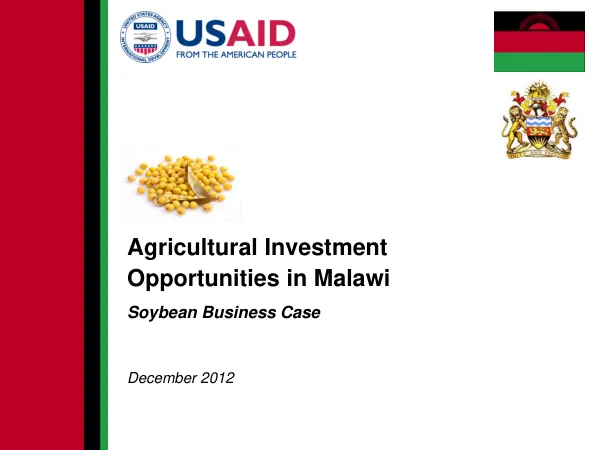
Agricultural Investment Opportunities in Malawi
Malawi, a Southern African country, boasts a diverse topography and scenery, ranging from sweeping lake views to breathtaking woodlands and unique cityscapes.
2012 · 30 pages
Sign in to readA free account is required to download.
Abstract
The country has a population of 15.4 million people and a land area of 118,500 square kilometers, comparable in size to the U.S. state of Pennsylvania. The capital city is Lilongwe, and the second-largest city, Blantyre, is the center for commercial activity. Lake Malawi, the third-largest lake in Africa, and Lake Chilwa cover approximately 21% of Malawi's land area, providing significant resources for water, tourism, and agriculture. Malawi's economy has experienced consistent growth over the last several years, with agriculture being an important contributor, representing 30% of GDP in 2011. The sector has grown at a compound annual growth rate of 12.8% and is expected to continue to be a major part of Malawi's economy. Agriculture is the single largest contributor to GDP, having grown at approximately 8.3% per annum from 2006 to 2011. The country possesses significant resources that support diverse crops, such as good water supplies, vast land resources, favorable agro-ecological conditions, and capable farmers. Malawi has five distinct agro-climatic zones: Highlands, Escarpment, Plateau, Upper Shire Valley, and Lower Shire Valley. These regions have different soil textures and rainfall patterns, and support a mix of crops including cereals, legumes, and an assortment of cash crops. The country has 3.6 million hectares of arable land, of which 2.1 million is already under cultivation. Approximately 42% of potentially productive land is yet unused, presenting vast potential to increase agricultural output. The majority of farmers possess at least basic skills in agriculture, and smallholder farmers are commercially inclined and respond to markets, growing crops they can sell. The investment opportunity in Malawi's agro industry is an established company looking to diversify into the processing of Textured Soy Protein (TSP) to serve local and regional markets. The firm is seeking a strategic partner to complement its existing inputs, network, and capabilities with an equity investment into plant and equipment, including machinery for soybean oil extraction and refinery. This investment is supported by growing local and regional demand, local soybean production that is expected to grow at 10% until 2016, and an increasingly enabling environment provided by the Government of Malawi. Soybean demand has shown strong growth across local and regional markets between 2006 and 2010, driven by the animal feed industry and growing human consumption, particularly in the form of TSP. Increasing production due to growth in cultivated area and yields provides the platform to serve local and regional demand. Limited local competition provides the opportunity for growth and expansion of companies already operating in the sector. The Government of Malawi is encouraging private sector-led growth through policy reforms, incentives to attract investment, and overarching sector-wide strategies that focus government intervention.
Related documents