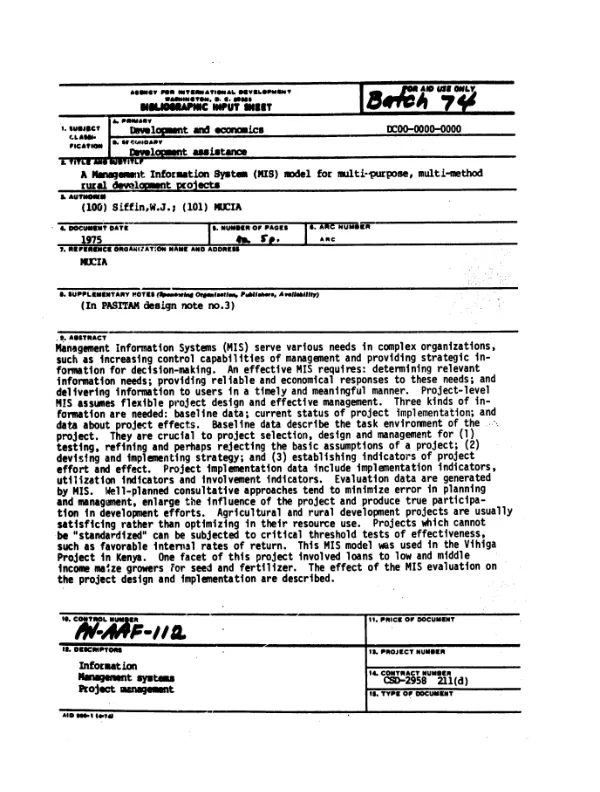
MIDWEST UNIVERSITIES CONSORTIUM FOR INTERNATIONAL ACTIVITIES, INC. (MUCIA)
Agricultural management information system; lessons from Masagana 99
A Management Information System (MIS) is essential to any large-scale agricultural development program involving synchronized local, regional and national-level decisions.
Stout, Russell · 1970
Sign in to readA free account is required to download.

Abstract
This does not necessarily require elaborate automatic data processing arrangements. The MIS may be built into field operations, with basic data obtained by agricultural technicians as part of their work. The key problem is likely to be the extent to which the data are actually used in top-level policymaking. In agricultural and rural development, reliable, timely information is usually hard to get. A Control MIS seems to be the most effective approach for this type of project. A few key data elements are selected for continuous observation, recording, statistical analysis and summarizing. When results fall outside established limits management is informed, investigates and takes appropriate action. The Masagana 99 MIS fits this category. The essential features of this model are described in detail. It has been in operation since May 1973 in the Philippines and is seen as an important step in building a permanent capacity within the National Food and Agriculture Council to monitor provincial level agricultural data. The Masagana 99 program has highlighted the need for decentralized decision making in Philippine agricultural development. Only the most basic activities can be programmed nationally, such as credit and fertilizer allocations and the assignments of key personnel. Short-range decisions can be monitored nationally, but can be made effective only at intermediate or provincial levels. The Masagana 99 MIS demonstrates that a good system can be developed without elaborate computerization or specialist field data collectors.