USAID DEC
Management information system (MIS) model for multi-purpose, multi-method rural development projects
Sign inMIDWEST UNIVERSITIES CONSORTIUM FOR INTERNATIONAL ACTIVITIES, INC. (MUCIA)
Management information system (MIS) model for multi-purpose, multi-method rural development projects
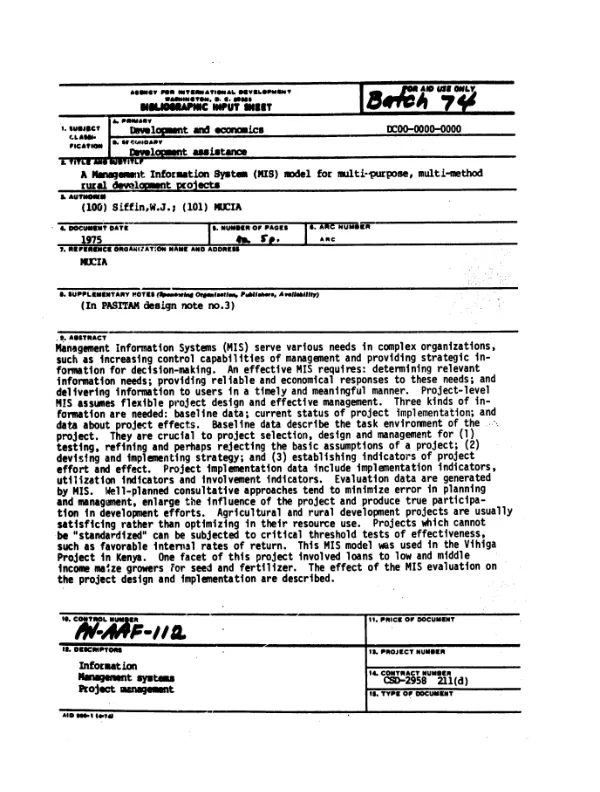
Management Information Systems (MIS) serve various needs in complex organizations, such as increasing control capabilities of management and providing strategic information for decision-making.
Siffin, William J. · 1970
Sign in to readA free account is required to download.
Abstract
An effective MIS requires: determining relevant information needs; providing reliable and economical responses to these needs; and delivering information to users in a timely and meaningful manner. Project-level MIS assumes flexible project design and effective management. Three kinds of information are needed: baseline data; current status of project implementation; and data about project effects. Baseline data describe the task environment of the project. They are crucial to project selection, design and management for (1) testing, refining, and perhaps rejecting the basic assumptions of a project; (2) devising and implementing strategy; and (3) establishing indicators of project effort and effect. Project implementation data include implementation indicators, utilization indicators and involvement indicators. Evaluation data are generated by MIS. Well-planned consultative approaches tend to minimize error in planning and management, enlarge the influence of the project and produce true participation in development efforts. Agricultural and rural development projects are usually satisfying rather than optimizing in their resource use. Projects which cannot be "standardized" can be subjected to critical threshold tests of effectiveness, such as favorable internal rates of return. This MIS model was used in the Vihiga Project in Kenya. One facet of this project involved loans to low- and middle-income maize growers for seed and fertilizer. The effect of the MIS evaluation on the project design and implementation are described.