USAID. MISSION TO HONDURAS
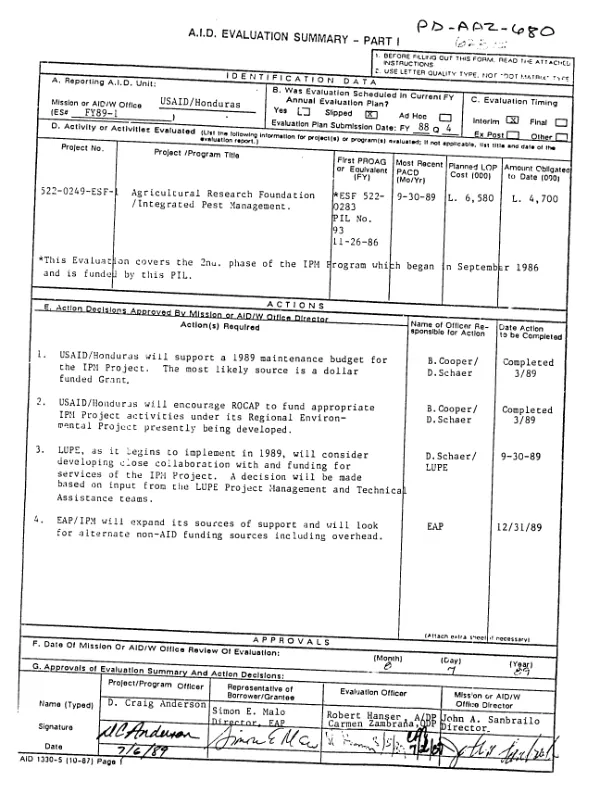
Agricultural research foundation/integrated pest management
Summarizes interim evaluation (PD-AAZ-680) of an integrated pest management (IPM) project being implemented at the Escuela Agricola Panamericana (EAP).
1989
Sign in to readA free account is required to download.
Abstract
Evaluation covered the period 9/86-9/88. Following are the major conclusions. (1) The project is carrying out its mandate in teaching, research and extension very effectively. (2) Project funding should be maintained at US$1,000,000 per year for the remaining years of the project and beyond. (3) The project contributes to the increased production of maize, beans, cabbage, and other crops. (4) The project maintains effective functional linkages with other agencies and institutions both in and out of Honduras. (5) Each of the EAP"s specialized centers serves an important function in Honduran plant protection. Several of the centers can be expected to become self-supporting. (6) The extension approach which involves farmers in the development process is effective and should be continued. (7) Extension, research, and teaching components strengthen one another; both small farmers and students benefit from this project. (8) The IPM program is consistent with and should contribute to the objectives of the proposed Land Use and Productivity Enhancement (LUPE) project. The IPM program should be incorporated into the LUPE project. The IPM plant protection technologies could serve to facilitate interaction with farmers. (9) Regional sources of revenue, especially ROCAP funding, should be considered because several components of the project are of a regional scope. (Author abstract, modified) See also abstract of PD-AAZ-023.
Related documents