CNFA, INC.
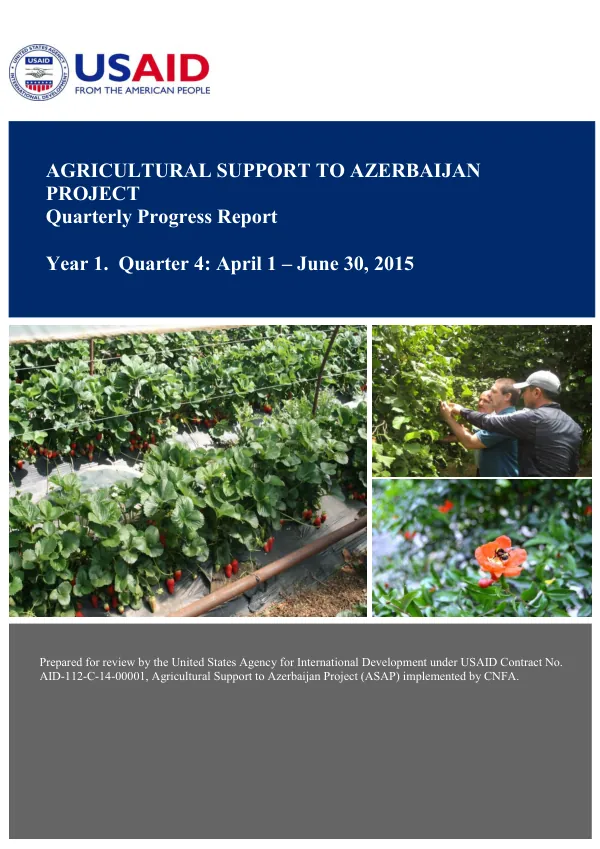
Agricultural Support to Azerbaijan Project (ASAP) Quarterly Progress Report
The Agricultural Support to Azerbaijan Project (ASAP) is a USAID-funded initiative implemented by CNFA.
2015 · 45 pages
Sign in to readA free account is required to download.
Abstract
The project's primary objective is to improve the quality and quantity of goods produced in Azerbaijan's agricultural sector. The project focuses on four value chains: hazelnut, orchard fruit, pomegranate, and vegetable and berry. During Quarter 4 of Year 1, ASAP provided ongoing field-based training to its beneficiaries, with a focus on data-driven recommendations for its Demonstration Plots. The project provided guidance on formulating and applying optimum mixtures of fertilizers and micro-elements, as well as field training on fertilization to growers of hazelnut and orchard fruits, including pomegranates, apples, and table grapes. ASAP also introduced clients to fertilization through spraying, which was well-received by growers who invested significant financial and human resources in adopting ASAP recommendations. Other technical assistance included the introduction of bumblebees for pollination of pomegranates, training in fruit thinning to prevent overbearing, which can reduce fruit size and quality, and various means of weed and pest control. To supplement this technical assistance to Demo Plots, the project also moved forward on procuring a "traveling gun" irrigation unit for a potato demo in Tovuz, a drip irrigation system for a hazelnut growing demo in Zagatala, and soil amendments to decrease soil pH for a table grape demo farm in Gusar. Several anticipated Technology Transfer Fund (TTF) activities were advanced during the reporting period. A proposed TTF investment in hazelnut product diversification was approved by ASAP's Technical Evaluation Committee, but was later modified to focus instead on quality assurance through the procurement and installation of a hazelnut laser sorting machine by a hazelnut processor in Zagatala. ASAP engaged an environmental consultant to conduct the required environmental review of the hazelnut processing facility and the planned TTF activity. A second hazelnut value chain-related application was placed on hold pending completion of the first TTF activity, due to the country's challenging enabling environment. The project's programs achieved significant progress during Quarter 4. In the hazelnut value chain, growers were trained on fertilization and introduced to fertilization through spraying. In the orchard fruit value chain, growers were trained on fruit thinning and introduced to bumblebees for pollination. In the pomegranate value chain, growers were trained on fruit thinning and introduced to various means of weed and pest control. In the vegetable and berry value chain, growers were trained on Good Agricultural Practices (GAP) and introduced to drip irrigation systems. The project's financial and expenditure summary for Quarter 4 shows that ASAP spent a total of $X, with $Y allocated to operations, $Z allocated to programs, and $W allocated to other administrative costs. The project's financial and expenditure summary also shows that ASAP received a total of $X in funding from USAID, with $Y allocated to operations, $Z allocated to programs, and $W allocated to other administrative costs. The project's monitoring and evaluation (M&E) activities continued during Quarter 4, with a focus on tracking progress towards the project's intermediate results (IRs). The project's M&E plan includes regular field visits, surveys, and data collection to track progress towards the project's IRs. The project's M&E plan also includes regular reporting to USAID and other stakeholders on progress towards the project's IRs. The project's environmental management and monitoring activities continued during Quarter 4, with a focus on ensuring that the project's activities do not harm the environment. The project's environmental management plan includes regular monitoring of the project's environmental impact, as well as measures to mitigate any negative impacts. The project's environmental management plan also includes regular reporting to USAID and other stakeholders on the project's environmental performance. The project's gender and ICT activities continued during Quarter 4, with a focus on promoting gender equality and improving access to information and communication technologies (ICTs). The project's gender plan includes regular training and capacity-building activities for women farmers, as well as measures to promote women's participation in the project's decision-making processes. The project's ICT plan includes regular training and capacity-building activities for farmers on the use of ICTs, as well as measures to improve access to ICTs for farmers. The project's collaboration with other assistance efforts continued during Quarter 4, with a focus on leveraging resources and expertise from other organizations to support the project's objectives. The project's collaboration plan includes regular meetings and coordination with other organizations, as well as measures to leverage resources and expertise from other organizations to support the project's objectives. The project's key constraints and lessons learned during Quarter 4 included the country's challenging enabling environment, which made it difficult to implement some of the project's activities. The project also learned the importance of engaging with local stakeholders and building their capacity to support the project's objectives. The project also learned the importance of monitoring and evaluating its activities regularly to ensure that they are