CNFA, INC.
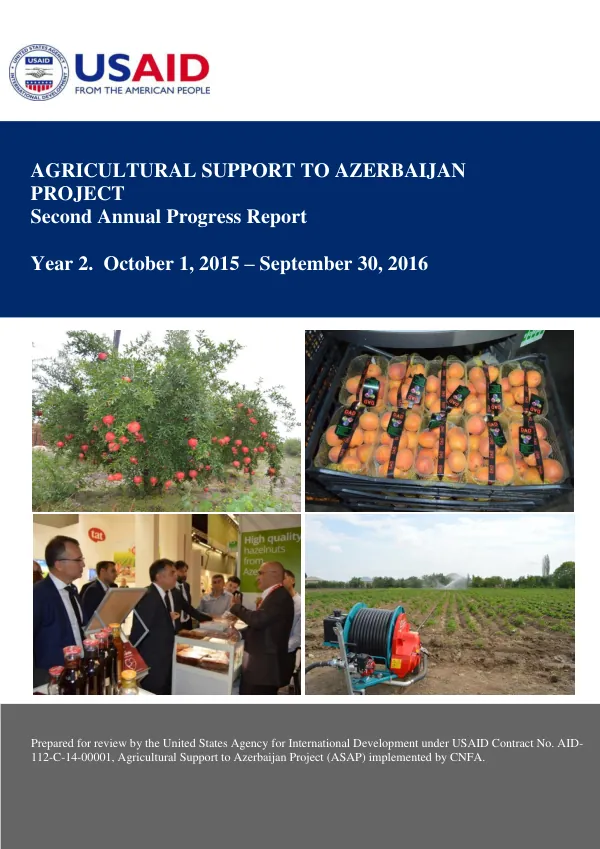
Second Annual Progress Report: Agricultural Support to Azerbaijan Project
The Agricultural Support to Azerbaijan Project (ASAP) was implemented by CNFA under USAID Contract No.
2016 · 115 pages
Sign in to readA free account is required to download.
Abstract
AID-112-C-14-00001. The project aimed to improve the quality and quantity of goods produced in Azerbaijan, with a focus on the hazelnut, orchard fruit, pomegranate, vegetable, and berry value chains. During the second year of the project, ASAP continued to provide field-based training to its current beneficiaries, while identifying new beneficiaries. Through its program of on-farm technical assistance, ASAP agronomists identified farms' needs and provided recommendations to maximize harvest volume and quality, despite less than ideal weather conditions. Farmers whose operations bordered Project-assisted growers learned from and adopted selected improved agricultural practices in place of traditional methods, resulting in visible improvements in their trees. In the Hazelnut Value Chain, this was an intensive year for the application of agricultural management practices, such as pruning and fertilization, to ensure higher productivity and yields. ASAP provided training and technical assistance on Good Agricultural Practices (GAP) in all beneficiary orchards, incorporating modules such as pruning, soil fertilization, microelement spraying, and preparation for harvest. ASAP also continued to encounter new neighboring growers who had emulated the practices being modeled on its demo plots. Despite a nationwide decrease in hazelnut yields, ASAP demo plots had much more fruit and the trees looked much healthier than those in neighboring orchards. ASAP's efforts in the Orchard Fruit Value Chain focused on improving the quality and quantity of goods produced. The project provided training and technical assistance to farmers on GAP, including pruning, soil fertilization, and microelement spraying. ASAP also established demonstration plots to showcase the benefits of improved agricultural practices. As a result, farmers in the region began to adopt these practices, leading to improved yields and quality of their produce. The project's Cross Cutting Activities aimed to promote Good Agricultural Practices (GAP) among farmers. ASAP established a Technology Transfer Fund to support the dissemination of new technologies and practices among farmers. The project also established a Business Support Provider (BSP) Technical Assistance Matching Fund to provide technical assistance to farmers. Additionally, ASAP worked to improve access to finance for farmers, promote quality and food safety, and monitor and evaluate the project's progress.